The Rezort

The-Rezort-Movie-Poster

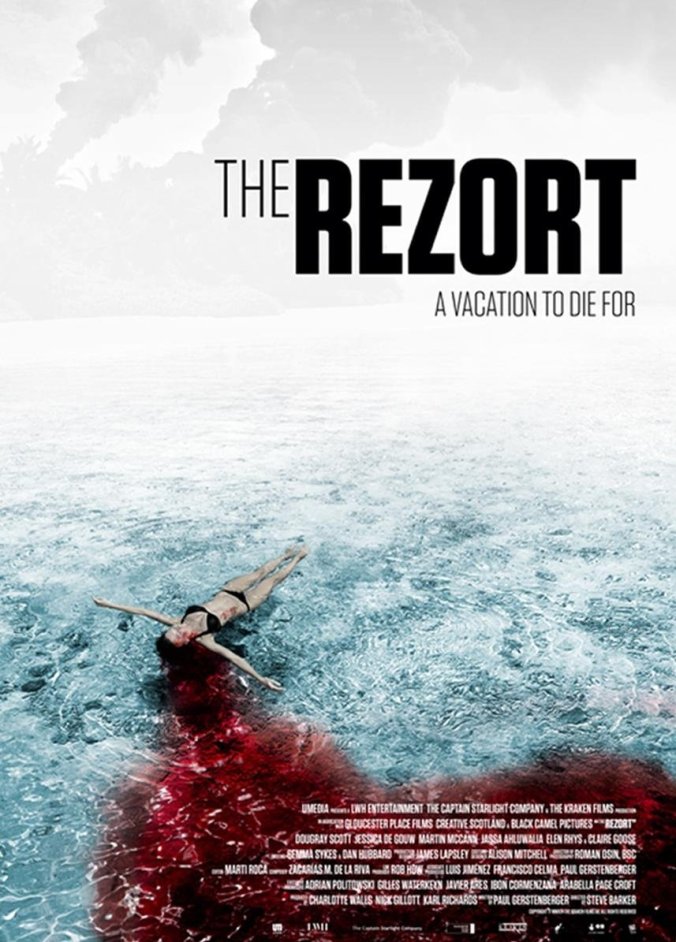
The Rezort—the 2015 British zombie movie directed by Steve Barker—cannot decide which is worse:  heartless corporate greed and opportunism or liberal crusading and do-gooder-ism. So, both are ultimately depicted with equal derision and disdain. And, more importantly for a film that traffics in undead slaughter and vicious butchery, the personification of each of those dueling societal ills gets their just comeuppance in the end…

Click here to read Madison Film Guy’s FULL review of The Rezort at Horrornews.net!

HNN

The Ones Below

tobposter

The Ones Below is a slow burn. No, strike that. The Ones Below is a leisurely, gradual, protracted, dawdling, painstakingly slow burn. In fact, it burns about as slowly as anything could possibly burn. It doesn’t spark, it doesn’t blaze, and it never bursts into flame. But The Ones Below smolders portentously from its opening frames until its final, lingering, heart-breaking shot, and it taps into a fertile thematic well of moral impotency, guilt, and postpartum despair…

Click here to read Madison Film Guy’s FULL review of The Ones Below at Horrornews.net!

HNN

Cafe Society

cafe-society2

Woody Allen has always had a particularly deft touch directing women.

Over the course of his career, an astounding twelve actresses have been nominated for thirteen Oscars for appearing in Woody Allen films, and six times they have walked away as winners. Diane Keaton started the streak at the 1978 Academy Awards, where she won Best Actress for Annie Hall. The next year, Maureen Stapleton and Geraldine Page were both nominated—Supporting Actress and Actress, respectively—for Interiors; and Mariel Hemingway was nominated the following year for her supporting turn in Allen’s masterpiece, Manhattan. At the 1987 Oscars, Dianne Wiest won Best Supporting Actress for Hannah and Her Sisters; and Judy Davis gave a volcanic performance, earning a Supporting Actress nomination, in 1992’s Husbands and Wives. Dianne Wiest and Jennifer Tilly both garnered nominations for Supporting Actress, with Wiest earning her second win, for Bullets Over Broadway in 1995. Mira Sorvino took home an improbable Supporting Actress Oscar the next year for Mighty Aphrodite. Samantha Morton earned a Supporting Actress nomination for 1999’s Sweet and Low Down. Penelope Cruz smoldered and erupted her way to a Supporting Actress win in 2009 for Vicky Cristina Barcelona. And then Sally Hawkins and Cate Blanchett were both nominated—Supporting Actress and Actress, respectively—with Blanchett the runaway winner for 2013’s Blue Jasmine.

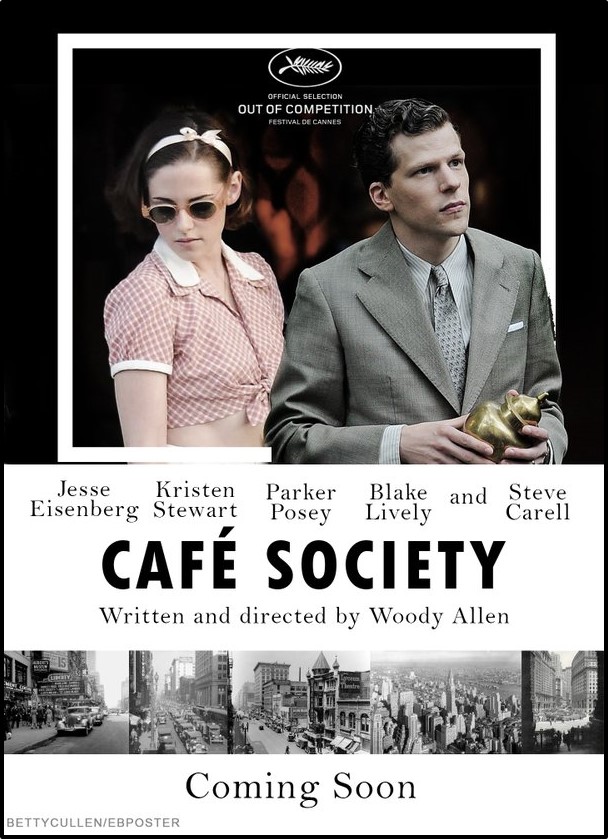
There won’t be any Oscar nominations for Allen’s latest film, Café Society, but once again it is the women who make the film worthwhile, mostly notably Kristen Stewart, who here crackles with intelligence, warmth, and charisma.

Café Society is set in the Hollywood and New York of the 1930’s, a bygone era of glamor, romance, and excitement that has been an obsession of Allen’s for decades. Bobby, a naïve young Bronx boy (Jesse Eisenberg), moves to the West Coast and falls in love with the secretary (Kristen Stewart’s Vonnie) of his uncle, a mogul-ish agent to the stars played by Steve Carell. The relationship gets complicated when Bobby discovers that he is the short leg in an isosceles love triangle, and—heart broken—he packs up and moves back to Manhattan to run a ritzy nightclub with his gangster brother (Corey Stoll).

In recent years, Allen’s movies have taken on the aspect of wistful novellas, often with omniscient, detached narrators doing the heavy lifting not only in terms of moving the plot forward but even in expressing and explaining the emotional state of his characters. In some instances—Vicky Cristina Barcelona and You Will Meet a Tall Dark Stranger—the device works to varying degrees. In others, like Café Society, it does not. Here, Allen’s voice over recitation of the plot—voiced by Allen himself—strips all the urgency out of the conflicts and interactions of the characters, literally telling us the story while relegating the scenes that the actors are left to play as random vignettes that merely serve to illustrate or punctuate his narration.

But while that narrative device slows and undermines the story, it is Jesse Eisenberg’s limp, tedious performance that ultimately deadens the proceedings entirely.

Eisenberg has given some interesting, effective performances in his career, including his Academy Award nominated turn in The Social Network, but after a solid effort last year in the underrated The End of the Tour, he is having a bad, bad 2016. From his desperately embarrassing Lex Luthor in Batman v. Superman: Dawn of Justice to the why-in-God’s-name-did-it-get-a-sequel Now You See Me 2, Eisenberg’s effort in Café Society makes it a trifecta of futility.

One common thread that weaves its way through Eisenberg’s 2016 travails is simply that the actor doesn’t fit the role. Eisenberg made his bones playing nerdy, awkward kids in movies like The Squid and the Whale, Roger Dodger, and Adventureland, and so turning in a career-best performance as those characters grown-up and embittered, as he did in The Social Network, made perfect sense. In Café Society, however, while Eisenberg fits as the shy, naïve Bronx kid who opens the story, he is not nearly up to the task of transforming into the confident, charismatic success that he is supposed to be by the end of the film. And willful suspension of disbelief may be the stock-and-trade of the Hollywood dream factory, but asking us to buy that Eisenberg can make both Kristen Stewart and Blake Lively fall in love with him over the course 96 minutes is simply a bridge too far.

Which brings us back to Stewart.
ks

For a young actress, Stewart has had an awfully prolific career so far, including ten films just since 2014 alone. All that experience has helped her tap and tame her natural, raw talent, and the magnetic charm and youthful maturity she puts on display in Café Society suggests an actress ready to come into her own.

While Stewart steals the show as the irresistible Vonnie, Parker Posey in a supporting role and Blake Lively in what is essentially an extended cameo both shine, as well. Posey, especially, gives more personality to what is basically just the sketch outline of a human being than most actors do to fully fleshed out characters, proving once again that one of Allen’s greatest assets as a director is his ability to take a great actress, point her in the right direction, and then just get out of her way.

As for Allen himself, his central preoccupations have changed little over the years, and Café Society reflects his passion for Hollywood of yesteryear, his love of all things New York, and his infatuation with gangsters and other streetwise character who—as he rhapsodized in Manhattan—“know all the angles”. And, of course, even in a trifling work like Café Society, Allen cannot help but ponder the core philosophical quandaries that he returns to time and time and time again in his oeuvre.

As one character opines in Café Society: “Socrates said, ‘The unexamined life is not worth living’. But…the examined one is no bargain.”

TLMEA

TLMEA

The depiction of surreal, nightmarish visions has had a long history in world cinema. From the classic German expressionism of The Cabinet of Dr. Caligari to the experimental giallo traditions of Italian cinema to the somewhat more mainstream horror movies of Cocteau, Lynch, and (relatively speaking) Argento: sustaining the pervasive sensation of nightmare throughout a full-length feature film is a task that even the masters of the genre wrestle with in their finest works. As a result, the purest distillation of nightmare on film tends to be the territory best trafficked by short and experimental film.

And that brings us to TLMEA

Click here to read Madison Film Guy’s FULL review of TLMEA at Horrornews.net!

HNN

Chubbies

chubbiesposter

The process of making a feature length motion picture requires an exceptional amount of time, commitment, and creative energy. Depending on the nature of the movie, there could be a large cast of actors and extras to direct, multiple locations to scout and prepare, a crew of professionals to assemble and deploy, a plot to be mapped out, dialogue to be written, and a whole host of critical technical duties to be performed:  lighting and camera work, sound recording and mixing, editing, special effects, and the list goes on and on. It truly requires a Herculean effort. The hard work and dedication that it takes to make a movie—any movie—deserves and demands at least some measure of respect, recognition, and appreciation.

Unless that movie is Chubbies

Click here to read Madison Film Guy’s FULL review of Chubbies here at Horrornews.net!

HNN

Ghostbusters

Ghostbusters_2016_film_poster

Ghostbusters was a preternatural hit back in 1984. It raked in $242 million dollars in gross domestic box office, established Bill Murray as a bonafide movie star, and was—for people of a certain age (cough, cough)—a legitimate cultural touchstone.

Released more than 30 years later, the remake—or reboot, if you prefer, considering there are likely to be plenty of sequels to come—does not rise to that level, but it is still fast-paced, consistently funny, high-quality summer entertainment.

The year is 2016, and New York City is grappling with an unusual spike in supernatural activity. Estranged academic collaborators Abby and Erin (Melissa McCarthy and Kristen Wiig) find themselves reunited by circumstance to investigate a local haunting, and they come face-to-face (and then some) with a malevolent apparition that more or less proves their metaphysical theories. When the video of their apparently-phantasmagoric encounter hits YouTube, both are fired from their academic posts—Erin from Ivy League Columbia University and Abby from a low-rent NYC technical college—leaving them little choice but to go into business for themselves as private paranormal investigators. Abby brings her assistant Jillian (Kate McKinnon) along with them, and eventually they add a fourth ghostbuster, Patty (Leslie Jones), and an oblivious-but-hunky secretary, Kevin (Chris Hemsworth), to their team. There is a modicum of political intrigue along the way and a forgettable human villain to be reckoned with, but mostly these gals spend the rest of this movie battling rampaging spirits from the great beyond.

Lest we forget the embarrassing, (let’s-just-call-it-what-it-is) misogynistic uproar over casting this film with four women instead of four men, Ghostbusters has been mired in hate-spewing social media controversy for the better part of the last year. A certain segment of the movie-going public found itself positively aghast that Ghostbusters 2016 would continue to prosecute the proverbial “war on men” that began when The Force Awakens planted a female character at the center of a galaxy far, far away. Angry trolls everywhere lashed out from their parents’ basements and filled online comment sections and social media timelines with vitriolic screeds of hate and disappointment, demanding that the filmmakers give them an XY reboot instead of the soft, fuzzy XX version that they were sure they’d get.

The irony of that, of course, is that in today’s Hollywood there is no comedian–male or female–with more box office clout than Melissa McCarthy, so why wouldn’t she headline a high-profile summer comedy? Add in Kristen Wiig—who single-handedly kept Saturday Night Live afloat for several seasons in the 2000’s and also headlined a little $170 million hit comedy called Bridesmaids—and you’ve got some serious juice behind this movie.

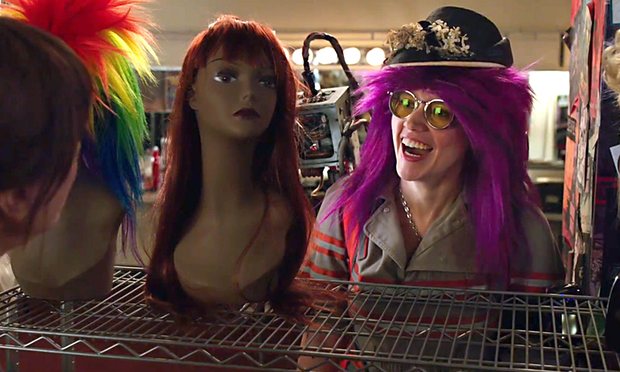
What’s interesting here, though, is that while McCarthy and Wiig anchor Ghostbusters admirably and do most of the heavy lifting in terms of plot development and emotional stakes, it is Kate McKinnon who delivers not only the lion’s share of the laughs but also the one true breakout performance of the film.

In a movie inspired by (kind of sort of) the Book of Revelation, McKinnon is a revelation unto herself.

Anyone who has watched Kate McKinnon on SNL over the past few years knows the raw comedic talent that she brings to the party. From her much-heralded take on Hillary Clinton to her smarmy imitation of Justin Bieber to her white trash alien abductee that forced character-breaking fits of laughter out of her fellow performers (hands-down the best sketch of SNL’s recent season), McKinnon has got the goods in spades.

kmwig

In Ghostbusters, McKinnon gets to spread her wings and experiment with a weird, probing performance that sets her apart from her costars in a way that really elevates the comedy. While McCarthy and Wiig get their laughs through more restrained performances and while Jones stays pretty much in the same box she has constructed for herself since coming onto the national scene, McKinnon gets to freestyle here, and the results are sublime. Like the background musician who suddenly overshadows the lead singer and brings the house down with an improvised guitar solo, McKinnon goes big and goes weird, making such interesting and unconventional choices with her character that you just can’t wait to see what she’s going to do next. More often than not, she gets it right and delivers.

Apart from McKinnon, one of the most notable things about this new Ghostbusters is its complete self-awareness and affection for its predecessor.

A parade of cameos throughout the film serve less as moments of comic inspiration than they do as endorsements from or tributes to the original Ghostbusters’ cast. Despite a flashy appearance by Bill Murray, the most affecting of these is a don’t-blink-or-you’ll-miss-it homage to Harold Ramis—co-writer and co-star of the original—who passed away in 2014 but appears here as a bronze bust outside Erin’s office at Columbia. Casual fans will recognize and appreciate the appearances by Murray, Dan Aykroyd, Sigourney Weaver, the Stay Puff Marshmallow Man, and others; but only the true fan will choke up over that brief glimpse of Ramis’ unmistakable figure standing guard in the hallway. His is the one ghost we hope our squadron of wonderful women warriors don’t blast back into the other dimension.

The Shallows

the-shallows-poster

The shark may well be the ultimate screen villain.

Deadly. Relentless. Without mercy. A killing machine with no pity, remorse, or shame. As someone said in the most famous shark movie of them all, “What we are dealing with here is a perfect engine, an eating machine. It’s really a miracle of evolution. All this machine does is swim and eat and make little sharks.”

And when it kills–whoa!—it kills in spectacular fashion.

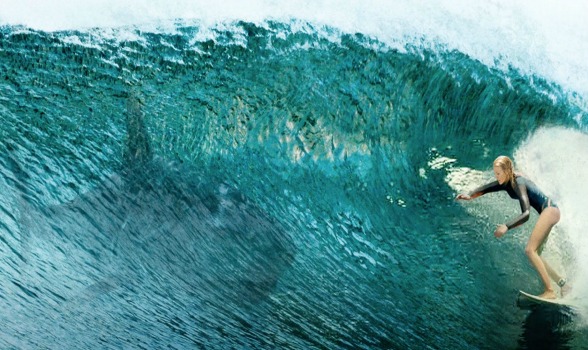
In time, The Shallows—the new thriller from Spanish director Jaume Collet-Serra—will be remembered, if at all, as just another shark movie. But in the moment, The Shallows is a taught, suspenseful survival tale that pits a game Blake Lively against Mother Nature’s perfect engine.

Lively’s grief-stricken surfer girl, Nancy, has lost her mother to cancer, left medical school, and retreated to a secluded Mexican beach to forget her troubles and ride the spectacular southern swells. Had she headed back to town after lunch, it truly would have been the perfect day. But, alas, she stays out a bit longer than she should, and before you can say “girl in peril”, she finds herself laying on an isolated rock two hundred yards from shore, blood gushing from a savage shark bite in her leg, and the rising tide threatening to wash her off of her safe place and into the jaws (no pun intended) of the great white shark lurking in the dark water. Facing near-impossible odds, the determined and resourceful Nancy rediscovers her lost will to live and sets about trying to find a way to get herself to safety before it’s too late.

Like many shark movies that take themselves seriously (no, I’m not talking to you, Sharknado), The Shallows must be judged against Spielberg’s 1975 masterpiece. That said, is it fair to say that The Shallows is better than one or more movies that has Jaws in its title followed by a number? Yes, absolutely. Does it even come close to the original Jaws? No way.

Then again, what does?

Jaws remains one of the most ground-breaking films of any genre in the history of film. Ranked number 48 on the American Film Institute’s roster of the 100 Greatest American Movies of All Time, Jaws is not only an outstanding film on the merits, but it also single-handedly created the idea of the summer blockbuster. For all the amazing things about Jaws, however—the phenomenal performances, the terrific writing, the rich characters—what is often lost about this timeless classic is just how good a horror film it really is. Jaws actually scares you. And it doesn’t just scare you in the moment: it lingers with you, it haunts you, and it plays with your mind whenever you dip your toe into the deep blue sea. It is not hype to say that an entire generation of moviegoers learned to be afraid of the water from Jaws.

The-Shallows-1-tiny

On its own terms, The Shallows provides its fair share of scares, as well, though its killer shark occasionally seems to be a bit too obsessed with  Nancy when, as the saying goes, there are plenty of other fish (and mammals, for that matter) in the sea. The great white of The Shallows seems to have been inspired by the masked killers of the 80’s slasher cycle in its single-minded drive to kill this one specific victim, but considering the tasty way in which the film presents Blake Lively, perhaps it’s hard to blame the precocious fish.

Especially in the film’s early scenes, director Collet-Serra leers at Lively. His gaze lingers on her every curve, from front to back, like a creepy neighbor in an upstairs window with a pair of binoculars.  He cuts from the magnificence of the secluded beach to the gorgeous tree line to Lively peeling off her clothes like she’s just another part of the scenery.

Lively, though, rises above it and proves to be much more than a pretty face. As the movie’s sole actor for probably 90% of its running time, Lively anchors the film effectively and does well to create a real character out of what essentially is a one-line scenario:  What would happen if a girl got caught alone on a rock in the middle of nowhere and had to match wills against a great white shark? There isn’t much room there for character development, but Lively does her level best.

In the end, though, The Shallows has little to do with character, plot, story, or any other element of traditional narrative. It’s about tension, suspense, and a massive, angry, lunging shark. In retrospect, that’s probably not enough. But in the dark of the theater, it makes for good, engaging summer entertainment.

Maggie’s Plan

mpposter1

Love is messy. An unoriginal observation, perhaps, but certainly right on the mark.

We fall in love. We fall out of love. We struggle to make it work. We mourn its passing. We take it for granted. We celebrate it. We covet it. And, at some point in our lives, we realize that love comes in all shapes, sizes, and varieties, though we don’t always get to choose the how’s or why’s or when’s or who’s. Leonard Cohen might have put it best when he sang, “To every heart, every heart, love will come…but like a refugee.”

Maggie’s Plan is all about love:  messy, complicated, grown-up love.

Greta Gerwig’s 30-something Maggie wants a baby. But she wants it on her own terms, on her own timetable, and to her own particular specifications. So Maggie sets off to engineer the little miracle, an effort that is complicated when she falls for married John (Ethan Hawke). Eventually, she decides that she wants John, too. On her own terms. On her own timetable. And to her own particular specifications. Before long, lucky Maggie has gotten exactly what she wanted—the baby, the man, and the life—but then starts to realize that she just might want something else, instead. On her own terms, on her own timetable…you get the idea.

The marketing folks behind Maggie’s Plan have packaged it as a “screwball comedy”, and it most decidedly is not that. Maggie’s machinations might be the stuff of screwball comedy, especially in the film’s second half, but the pace, performances, and tone of the film never actually rise to that screwball pitch. Instead, the film settles into a comfortable, leisurely gait, delivering some laughs, for sure, but at last becoming much more affecting than you ever expect going in.

Writer/director Rebecca Miller (The Private Lives of Pippa Lee, The Ballad of Jack and Rose) has a lot to say about adult love and relationships. The film starts out a bit uneven, the characters clichéd and two-dimensional, but as the film presses forward the characters begin to come into more clear focus and their motivations and reactions become more complex. It may be that writer-Miller was ultimately rescued by director-Miller, whose ability to masterfully conduct her orchestra of actors allows the film to find its way.

Of the three leads at the heart of Maggie’s Plan, Julianne Moore starts off on the shakiest ground. Playing John’s intellectual, ambitious wife, Georgette—broadly drawn as a caricature, outlandish accent and all—Moore quickly pivots away from her early over-the-top take on the character and by the end delivers a fully-realized, three-dimensional performance.

Ditto Ethan Hawke, who—truth be told—is never so effective as when he portrays slacking, emotionally-immature, self-centered dreamers. In that regard, John is tailor-made for the actor: a philandering would-be-novelist who romanticizes his love affair with a never-finished manuscript even as it seduces him into neglect and abandonment of his real-world relationships.

The irresistible force at the center of Maggie’s Plan, however, is the utterly indefatigable Greta Gerwig, into whose orbit the other characters dance and play and come and go like shooting stars. In the six years since her career kick-starter Greenberg, Gerwig has come to define indie-cred and indie-cool. From Lola Versus to Frances Ha to Mistress America and now Maggie’s Plan, Gerwig has cornered the market on the existential angst of going from young adult to actual grown up. In Maggie’s Plan, she is educated, has a good job at the New School in New York, but struggles to achieve a degree of personal happiness to go with her professional success. And she makes a hell of a lot of mistakes along the way.

Despite Gerwig’s natural charm and irresistible charisma, even admitted Gerwig obsessives (and believe me, I know of what I speak) will find Maggie a tad off-putting. She is not a bad person, per se, but her tendency towards manipulation, duplicity, and self-deception—while making her very real, certainly—suggests caution before letting her get too close to your heart. Indeed, only during a handful of disarming moments with her young daughter Lilly does Maggie let her guard down and allow herself instants of genuine joy and love, but those are few and far in between.

Not that John or Georgette are such saints, either. It would seem that the central requirement for occupying a corner of Maggie’s love triangle is total self-centeredness and a lack of self-awareness. In fact, that combination may well have been the recipe for the “screwball comedy” that the marketers imagined.

Instead, though, after a few early bumps in the road and despite a bit of plot silliness here and there, Maggie’s Plan turns out to be an honest, engaging snapshot of yearning, aspiration, heartache, and—though the arrow never quite lands where it is aimed—that lonely refugee love.

The Witch

thewitch

The terror flares suddenly: shocking, disturbing moments and images that combust, scald, and then leave you in lingering psychological distress. Until the next flash, moral dread smolders sinisterly and mockingly, waiting for the next opportunity to shock you once again.

Such is the horror of The Witch.

A breakout hit at Sundance last year, The Witch earned first-time director Robert Eggers the top prize in directing, and in the intervening year distributers have used that indie cred, terrific word of mouth, and aggressive social media marketing to build Blair Witch Project levels of anticipation. And the film ends up to be well worth the wait.

A skin-crawling exercise in Christian paranoia and psychological horror, The Witch begins with the ouster of a devout Puritan family—for reasons not entirely clear—from their Salem-era New England plantation town. The family settles in the wilderness on the edge of a foreboding forest, builds a home, and sets about trying to establish a farm and a new life. When their infant son, Samuel, disappears suddenly while in the care of teenage daughter Thomasin, the family dynamics unravels rapidly, leading to suspicion, resentment, and an overwhelming sense of inexorable dread. At no point is there any doubt that this family is doomed, and as the story unfolds, the only question becomes whether it will be internal or external forces that ultimately destroy them.

One of the triumphs of The Witch is its ability to take the mundane or the innocuous and infuse it with disturbing portent. A rabbit in the forest staring down a hunter fumbling with his rifle. Fraternal twins Mercy and Jonas romping in the yard with the family goat, Black Phillip. An innocent game of peek-a-boo that ends catastrophically. The deceptions, impotency, and sin that overwhelm this family infect every aspect of their lives, coloring their perceptions, driving their reactions, and pushing them along their hopeless path.

At the epicenter of The Witch stands Thomasin—played by newcomer Anya Taylor-Joy, in her first credited screen role—whose transformation from girl to woman is fueling the dark forces that tear the family apart. Taylor-Joy delivers a pitch-perfect performance full of innocence, fear, confusion, discovery, anger, trepidation, and wonder. As Thomasin, she dances amongst the contradictions, alternatively withdrawing into herself and then exploding in defiance of the sinister influences all around her.

Modern horror fans will split over The Witch. More Rosemary’s Baby than recent horror hits like The Purge, Insidious, or Paranormal Activity, the slow-burn of The Witch offers precious few moments of sneak-up-behind-you shock, sudden violence, or gore. And when those types of moments do come, they come and go in an instant, imprinting on the viewer’s psyche and then receding into the ether, leaving you to wonder what it was you actually saw or what it meant.

The Witch isn’t particularly interested in explanations or clarifications. It simply casts its spell; conjures its brew of unease, anxiety, and dread; and then casts you out of the darkness of the theater and into the darkness of your own mind to let you decide what it all meant.

You may not like the answer.