The Witch

thewitch

The terror flares suddenly: shocking, disturbing moments and images that combust, scald, and then leave you in lingering psychological distress. Until the next flash, moral dread smolders sinisterly and mockingly, waiting for the next opportunity to shock you once again.

Such is the horror of The Witch.

A breakout hit at Sundance last year, The Witch earned first-time director Robert Eggers the top prize in directing, and in the intervening year distributers have used that indie cred, terrific word of mouth, and aggressive social media marketing to build Blair Witch Project levels of anticipation. And the film ends up to be well worth the wait.

A skin-crawling exercise in Christian paranoia and psychological horror, The Witch begins with the ouster of a devout Puritan family—for reasons not entirely clear—from their Salem-era New England plantation town. The family settles in the wilderness on the edge of a foreboding forest, builds a home, and sets about trying to establish a farm and a new life. When their infant son, Samuel, disappears suddenly while in the care of teenage daughter Thomasin, the family dynamics unravels rapidly, leading to suspicion, resentment, and an overwhelming sense of inexorable dread. At no point is there any doubt that this family is doomed, and as the story unfolds, the only question becomes whether it will be internal or external forces that ultimately destroy them.

One of the triumphs of The Witch is its ability to take the mundane or the innocuous and infuse it with disturbing portent. A rabbit in the forest staring down a hunter fumbling with his rifle. Fraternal twins Mercy and Jonas romping in the yard with the family goat, Black Phillip. An innocent game of peek-a-boo that ends catastrophically. The deceptions, impotency, and sin that overwhelm this family infect every aspect of their lives, coloring their perceptions, driving their reactions, and pushing them along their hopeless path.

At the epicenter of The Witch stands Thomasin—played by newcomer Anya Taylor-Joy, in her first credited screen role—whose transformation from girl to woman is fueling the dark forces that tear the family apart. Taylor-Joy delivers a pitch-perfect performance full of innocence, fear, confusion, discovery, anger, trepidation, and wonder. As Thomasin, she dances amongst the contradictions, alternatively withdrawing into herself and then exploding in defiance of the sinister influences all around her.

Modern horror fans will split over The Witch. More Rosemary’s Baby than recent horror hits like The Purge, Insidious, or Paranormal Activity, the slow-burn of The Witch offers precious few moments of sneak-up-behind-you shock, sudden violence, or gore. And when those types of moments do come, they come and go in an instant, imprinting on the viewer’s psyche and then receding into the ether, leaving you to wonder what it was you actually saw or what it meant.

The Witch isn’t particularly interested in explanations or clarifications. It simply casts its spell; conjures its brew of unease, anxiety, and dread; and then casts you out of the darkness of the theater and into the darkness of your own mind to let you decide what it all meant.

You may not like the answer.

Black Sabbath

black_sabbath_poster

“I’m…hungry.”

When you or I mutter those words, it might foreshadow an assault on the refrigerator or a quick trip to a favorite gastropub.

But when Boris Karloff utters those words, with his trademark eye twinkle and lip curl, you’d better get yourself and your loved ones inside and lock all the doors and windows.

Such is the lesson of Black Sabbath.

The anthology format has long been a staple of the horror film: bite-size stories strung together either by common source author (1962’s Tales of Terror or 1963’s Twice Told Tales), common creative hook (1983’s Twilight Zone: The Movie or 2012’s V/H/S), some sort of common thread that binds the stories together (1988’s Waxworks or 2007’s Trick ‘r Treat), or some other hook.

1963’s Black Sabbath is neither the first nor the best of that tradition, but in uniting Italian master Mario Bava with horror icon Karloff, the film carves out its own delightful niche in horror history.

In addition to starring in one of the three tales of the film, Karloff “hosts” Black Sabbath in a series of cheesy (some might say unfortunate) introductions that offer a few chuckles but function exclusively to get us from one story to the next.

witch

The first story, called “The Drop of Water”, is set in London and follows the misadventures of an outcall nurse who gets summoned in the middle of the night to prepare the corpse of a witch who died in her mansion home overnight. When the nurse makes the fatal decision to steal the witch’s ring off her hand while she dresses the body, it sets in motion a nightmarish evening of otherworldly revenge. “The Drop of Water” is classic Bava, with gothic atmosphere; sudden, startling images; and a slow march toward inevitable revenge. The first glimpse we see of the dead witch in her bed—crazy eyes wide open, lips curled back in a menacing smile—does send chills up and down the spine, and “The Drop of Water” ends up to be a largely satisfying first chapter of the film.

telephone

“The Telephone”, the second of the three tales, involves a French call-girl who returns home from “work” one evening and begins to receive a series of threatening telephone calls that escalate in their intensity over the course of the night. The sexuality of “The Telephone” is pervasive, not only in the long, lingering shots of lead Michele Mercier’s perfect body and her suggestively sensual interactions with the woman she calls for help, but also in the violently sexual overtones of the threats she suffers. In “The Telephone”, suspense and teasing are two side of the same coin, as are fear and titillation, desire and hatred, and sex and violence. And it is all practically incomprehensible. The original Italian version of the film planted this story firmly in the real world; but in adapting this sequence for American release, changes were made to add supernatural elements to the story. Those changes completely muddle the tale and ultimately undermine the segment, making it by far the weakest of the three.

karloff-BLACKSABBATH

The coup de grace, however, is the third segment, “The Wurdalak”, featuring Karloff as Gorca, an elderly Russian vampire-like creature who must feast on the blood of those he loves in order to survive. Bold and atmospheric, “The Wurdalak” feels like the perfect mesh of classic Italian horror and the sensibilities of American International Pictures (AIP), the famous low-budget American studio that distributed Black Sabbath in the United States. A feast of classic horror tropes, “The Wurdalak” offers up vampires stalking the rubble of ruined castles, a baleful child demon, savagery and seduction, and Karloff. Oh Karloff! The horror icon rumbles through “The Wurdalak” like a force of nature, menacing and tragic at the same time, playful but intense, a vintage performance from a master of horror.

Ultimately, Black Sabbath is a bit too uneven to qualify as a total triumph, but the first and last segments offer enough simple pleasures and jolts and scares to satisfy any classic horror lover’s appetite.

Like Karloff’s Gorca, you may start the proceedings with a gnawing hunger that you can’t quite understand, but by the end of Black Sabbath you will have found yourself well-fed and gratified.

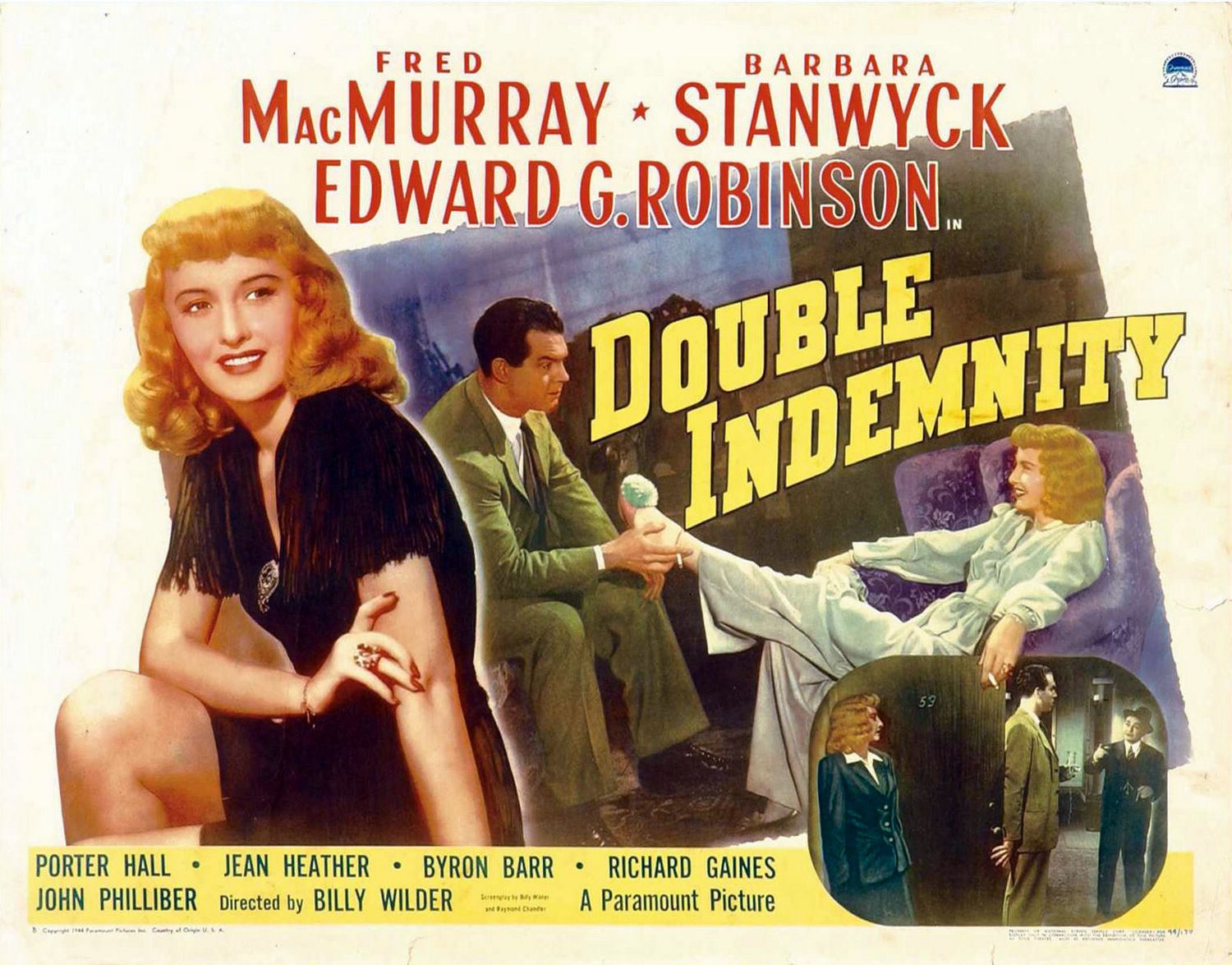
Double Indemnity: Double the Fun 70 Years Later

Double-Indemnity1

Turns out the insurance business is a hell of a lot more interesting than most of us think.

Between the wise-cracking salesmen, the dangerous women, the tough-as-nails claims adjusters, and all the schemes, twists, and intrigue, it’s no wonder that premiums tend to spiral out of control.

Or at least that’s the impression you get from Billy Wilder’s deliciously-fun Double Indemnity.

Based on a 1935 novella by James M. Cain—which, in turn, was based on a famous murder plot perpetrated in Queens, NY, in 1927—Double Indemnity is the story of a successful, fast-talking, low-character insurance salesman, Walter Neff, who falls for the wrong woman and gets tangled up in a plot to murder her husband for the insurance payoff. When the woman, Phyllis Dietrichson turns out to not be the abused, innocent victim that she initially appeared to be, things spiral fatally out of control for Neff.

From the first frame to the final image, Double Indemnity is a pulsating popcorn thriller, through-and-through.

It took nearly a decade for Double Indemnity to make the leap from story to screen, primarily because of the then-controversial nature of the material. Although a studio bidding war erupted shortly after the publication of the novella, it ended quickly when the infamous Hays Office began strictly enforcing the “moral guidelines” of the Motion Picture Production Code. Although codified in 1930, the so-called Hays Code was not aggressively enforced until circa 1934, and when the Hays Office got wind of the bidding war over the rights to Double Indemnity, it issued a stern warning to the major studios.

“The general low tone and sordid flavor of this story,” Hays Code enforcer Joseph Breen wrote, “makes it, in our judgment, thoroughly unacceptable for screen presentation before mixed audiences in the theater. I am sure you will agree that it is most important…to avoid what the code calls ‘the hardening of audiences,’ especially those who are young and impressionable, to the thought and fact of crime.”

Eight years after Double Indemnity’s first flirtation with Hollywood, Paramount tried again, buying the rights to the film and eventually getting a film treatment approved by the Hays Office. The project was then handed off to writer-director Billy Wilder, who collaborated on the screenplay with Raymond Chandler, then a first-time Hollywood screenwriter. Chandler was only a few years removed from his breakout first novel, The Big Sleep, but even Wilder (rightly) credits much of Double Indemnity’s success to what would soon become Chandler’s trademark gift for crackling, amped-up dialogue. “Yes, I killed him,” Neff confesses in the film’s opening scene. “I killed him for the money and a woman. And I didn’t get the money, and I didn’t get the woman. Pretty, isn’t it?”

It wasn’t just the Production Code that threatened to derail Wilder’s movie, though.

None of the three leads—Fred MacMurray as Neff, Barbara Stanwyck as Dietrichson, and Edward G. Robinson as hard-boiled claims adjuster (hard-boiled claims adjuster!) Barton Keyes—actually wanted to be in the film.

MacMurray and Stanwyck, both already box office stars, objected to playing such seedy, unseemly characters. In fact, MacMurray wasn’t even the studio’s first choice, but after Alan Ladd, James Cagney, Spencer Tracy, Gregory Peck, Fredric March, and George Raft all turned the role down, MacMurray became Wilder’s last resort. Eventually, through sheer force of will, Wilder signed both his leads, also securing Robinson despite the actor’s misgivings about playing what amounted to a supporting role for the first time since he became a star.

As it turns out, Double Indemnity is the best film that any of them ever made.

Double Indemnity rolled through Madison last week as part of the Turner Classic Movies’ “TCM Presents” series. To my discredit, I’d never discovered Wilder’s classic before, but 70 years after hitting theaters for the first time, Double Indemnity still feels as fresh and engaging as any new release you might find at the multiplex. Highly stylized, fast-paced, and ruthless, the film hooks you immediately with the first-scene appearance of Neff, who mysteriously stumbles into his insurance office, wounded and struggling, and spills his sordid story into a Dictaphone machine. From there, his confession spools out in voice over, and the film never slows down.

Part of the fun of Double Indemnity is watching the two leads, especially MacMurray, play against type. For someone who grew up knowing MacMurray primarily as the lovable father on My Three Sons and as the Flubber-inventing hero of The Absent-Minded Professor, it’s a delight seeing him play the snake-charming, amoral insurance salesman Walter Neff.

But as a life-long film buff, the wonder of finally catching up with Double Indemnity is seeing what many critics (though not all) identify as the first real example of American film noir, and seeing so many of the classic elements of noir come together on screen for the first time. The unseemly characters whose lust and greed set the wheels in motion for their own inevitable destruction. The stylized lighting and masterful mis-en-scene that pull you into the characters’ hearts and minds. The rat-a-tat-tat dialogue that slips from seduction to scheming without losing a beat.

And oh that femme fatale!

Stanwyk’s treacherous blonde seductress rivets from her first appearance on-screen, getting her hooks immediately into Neff with demure, playful allure. Like Neff, we go right along with her for the ride, slowly discovering her devious motives, her malicious intent, and ultimately her double-crossing plot. By the time he figures out the truth about her, his fate has already been sealed, and all that is left for him to do is to stumble through the final act of his deadly tale.

“Suddenly it came over me that everything would go wrong,” Neff mutters in voice over. “It sounds crazy, Keyes, but it’s true, so help me. I couldn’t hear my own footsteps.”

“It was the walk of a dead man.”

The Madness of Doctor X

doctorxposter

Mad scientists occupy a special place of honor in the pantheon of horror.

Sometimes misguided, sometimes megalomaniacs, sometimes simply evil for the sake of evil: mad scientists come in all shapes and sizes and have rivaled vampires, zombies, and giant monsters as the primary threat to cinematic civilizations for more than a century. The fear and mistrust inspired by horror cinema’s rich tradition of reckless experiments, out-of-control technology, and scientists determine to rule the world still impact our culture and politics today.

Henry Frankenstein (or Victor, if you’re a purist) may be the most famous: inspired to create life from dead tissue, he animated a creature so foul and monstrous that even he came to realize that it must be destroyed. But Frankenstein hardly stands alone. From Doctor Jekyll to Doctor Heiter: horror fans know all the names and all the schemes.

Which is why it was such a delight to stumble across Doctor X.

Released in 1932, Doctor X upped the ante on the still-young mad scientist subgenre by offering up five—count ‘em, five!—mad doctors for our viewing pleasure.

When New York City finds itself terrorized by a series of gruesome murders perpetrated under the pale light of the full moon, five colleagues at a prestigious medical research academy come under suspicion. It seems that the “Moon Killer” uses a special scalpel in his crimes that can only be found at that particular facility, meaning that one of the five researchers must be the fiend. Unfortunately, finding the actual killer proves to be a difficult task, as the five of them collectively tick off every transgressive box one can imagine: intellectual arrogance, delusions of grandeur, sexual perversion, fixation on the sinister power of moonlight, and even fascination with cannibalism. (Three of them—count ‘em, three!—have potentially cannibalistic tendencies, which must be a record for prestigious medical research academies.)

Given 48 hours by the police to root out the killer among them, Doctor Xavier—the head of the academy—whisks the sinister bunch off to his spooky, beach-side mansion. There, he intends to conduct an ethically-questionable psychological experiment: a re-enactment of the Moon Killer’s crimes designed to reveal guilty party.

There is other business to attend to, of course—Doctor Xavier’s beautiful daughter (a pre-King Kong Fay Wray), the meddling reporter (Lee Tracy), and the alternatively creepy (George Rosener) and comical (Leila Bennett) household staff—but for most of the film the focus remains locked exactly where it should be: on the five suspicious scientists and the race against time to unmask the Moon Killer.

Based on the movie’s title, it might appear that the mystery would be a particularly easy one to solve, but one of the most compelling things about this film is its ability to maintain suspense and to conceal the Moon Killer’s identity right up to the big reveal. Each of the five mad scientists stands alone as an interesting, compelling character, and their individual rivalries and quarrels ratchet up the tension and provide the conflict that keeps the plot moving forward. It is to the credit of the actors—first and foremost Lionel Atwill as Doctor X himself—that none of these characters comes off as stock or shallow.

Today, Atwill’s horror resume’ stands on its own, but at the time of Doctor X, he was still years away from his signature performances in films like Mark of the Vampire, Captain Blood, Son of Frankenstein, and as Professor Moriarty in Sherlock Holmes and the Secret Weapon. Here he headlines an outstanding cast that features Preston Foster, John Wray, Harry Beresford, and Arthur Edmund Carewe as the rest of the motley band of potential killers.

What really makes Doctor X an effective horror film, however, is the unflinchingly jagged edge of the material. Produced before aggressive implementation of the infamous Motion Picture Production Code, Doctor X deals openly with themes like cannibalism, rape, and brutal murder, themes that would soon be subject to censorship under the Code.

At the same time, the production design and direction (Michael Curtiz helmed this one) give full visual expression to the risque’ material. Shot in early Technicolor, the film’s awkward hues, urgent close-ups, and menacing set design fuel the film’s ability to maintain a sense of dread that drives it through a highly entertaining 76 minutes.