Ghosthunters

ghosthunters-2106-movie-pearry-reginald-teo-poster

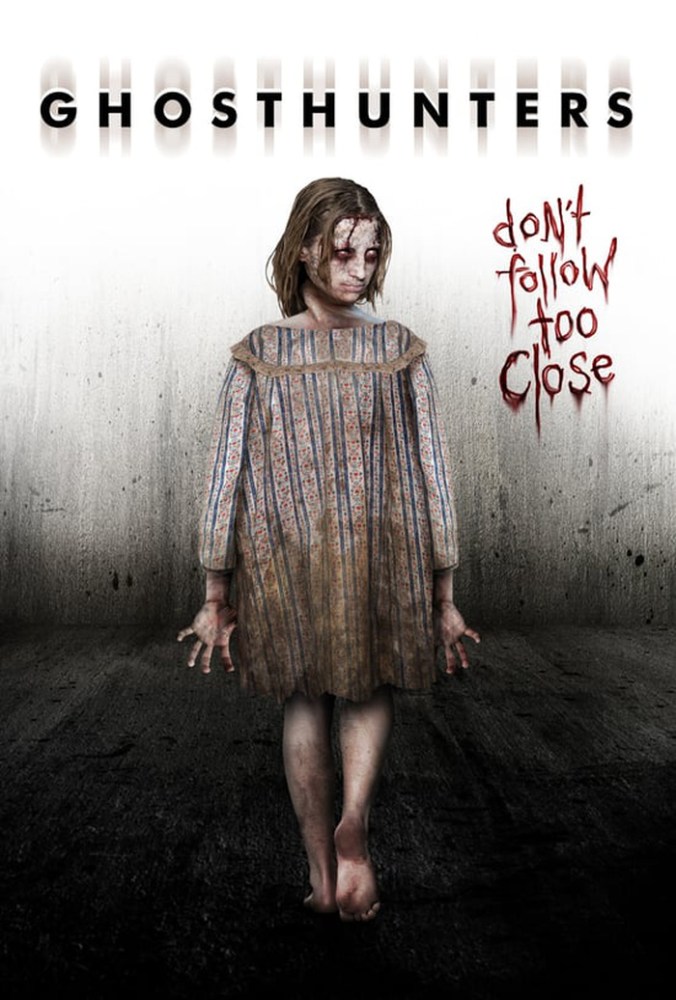
Some would say that bad decisions are the stock-in-trade of the horror film. No matter how smart the character or how harrowing the environment, characters in horror movies just can’t help making bad—like really, really bad—decisions. Characters in horror movies ignore ominous warnings that come from beyond the grave. They turn their backs on dangerous threats. They separate when they should stay together. They run up the stairs when they should run out the door. They don’t bother to look for companions who have wandered off and never returned. They follow voices into dark rooms when they definitely should know better. And they never seem to recognize just how much danger they are in…no matter how obvious is actually is.

And at this point I’m just talking about Ghosthunters

Click here to read Madison Film Guy’s FULL review of GHOSTHUNTERS at Horrornews.net!

HNN

Big Bad

Big-Bad-2016-movie-Opie-Cooper-7

If you dig Glee and the High School Musical flicks, you just might like Big Bad. If you’re waiting with bated breath for the new seasons of all your favorite Nickelodeon shows, you’ll probably really enjoy Big Bad. And if you’re twelve years old and a fan of overproduced, underacted, and minimally-plotted PG-ish pseudo-horror, then odds are you’ll love Big Bad.

For the rest of you, enter this movie-going experience at your own risk…

Click here to read Madison Film Guy’s FULL review of BIG BAD at Horrornews.net!

HNN

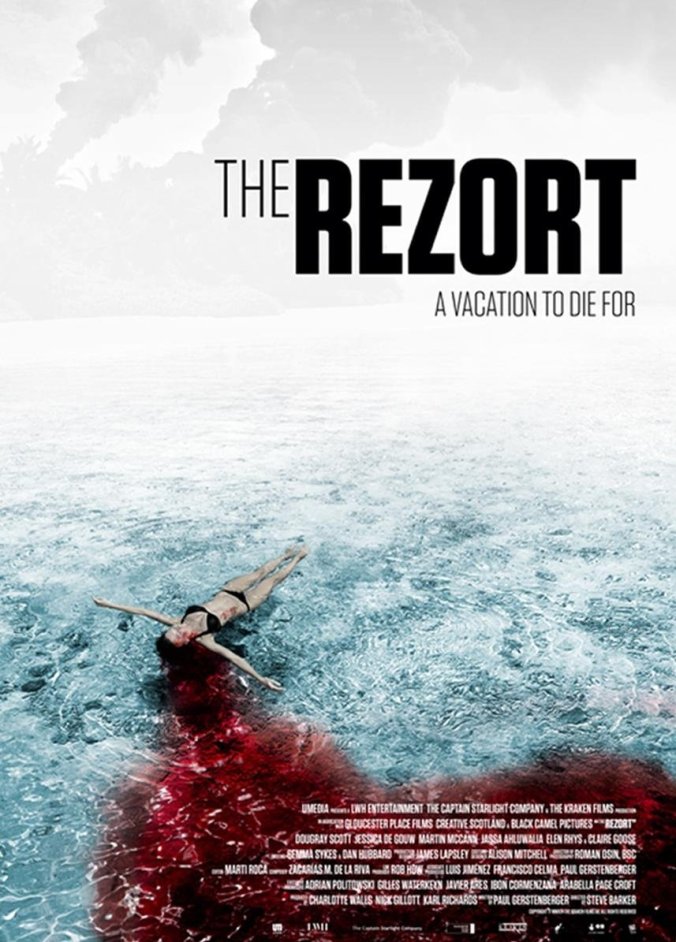
The Rezort

The-Rezort-Movie-Poster

The Rezort—the 2015 British zombie movie directed by Steve Barker—cannot decide which is worse:  heartless corporate greed and opportunism or liberal crusading and do-gooder-ism. So, both are ultimately depicted with equal derision and disdain. And, more importantly for a film that traffics in undead slaughter and vicious butchery, the personification of each of those dueling societal ills gets their just comeuppance in the end…

Click here to read Madison Film Guy’s FULL review of The Rezort at Horrornews.net!

HNN

The Ones Below

tobposter

The Ones Below is a slow burn. No, strike that. The Ones Below is a leisurely, gradual, protracted, dawdling, painstakingly slow burn. In fact, it burns about as slowly as anything could possibly burn. It doesn’t spark, it doesn’t blaze, and it never bursts into flame. But The Ones Below smolders portentously from its opening frames until its final, lingering, heart-breaking shot, and it taps into a fertile thematic well of moral impotency, guilt, and postpartum despair…

Click here to read Madison Film Guy’s FULL review of The Ones Below at Horrornews.net!

HNN

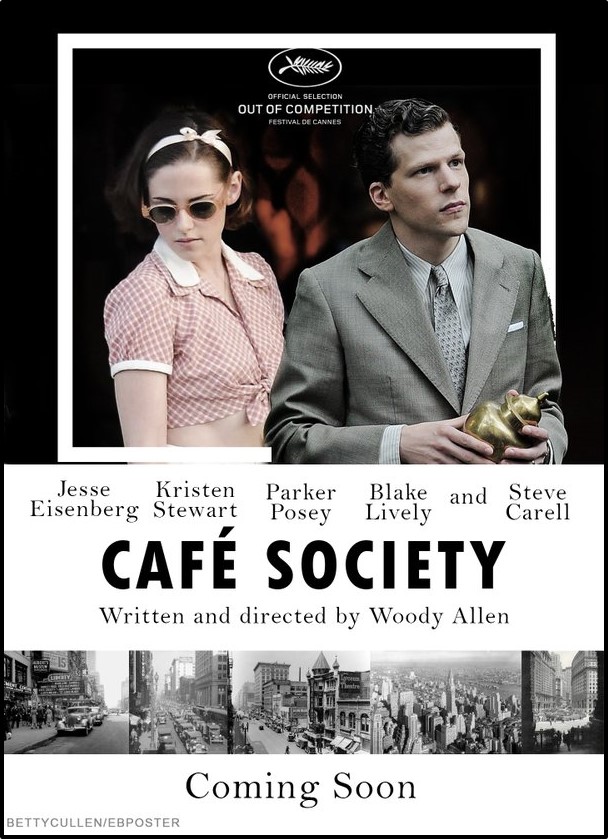
Cafe Society

cafe-society2

Woody Allen has always had a particularly deft touch directing women.

Over the course of his career, an astounding twelve actresses have been nominated for thirteen Oscars for appearing in Woody Allen films, and six times they have walked away as winners. Diane Keaton started the streak at the 1978 Academy Awards, where she won Best Actress for Annie Hall. The next year, Maureen Stapleton and Geraldine Page were both nominated—Supporting Actress and Actress, respectively—for Interiors; and Mariel Hemingway was nominated the following year for her supporting turn in Allen’s masterpiece, Manhattan. At the 1987 Oscars, Dianne Wiest won Best Supporting Actress for Hannah and Her Sisters; and Judy Davis gave a volcanic performance, earning a Supporting Actress nomination, in 1992’s Husbands and Wives. Dianne Wiest and Jennifer Tilly both garnered nominations for Supporting Actress, with Wiest earning her second win, for Bullets Over Broadway in 1995. Mira Sorvino took home an improbable Supporting Actress Oscar the next year for Mighty Aphrodite. Samantha Morton earned a Supporting Actress nomination for 1999’s Sweet and Low Down. Penelope Cruz smoldered and erupted her way to a Supporting Actress win in 2009 for Vicky Cristina Barcelona. And then Sally Hawkins and Cate Blanchett were both nominated—Supporting Actress and Actress, respectively—with Blanchett the runaway winner for 2013’s Blue Jasmine.

There won’t be any Oscar nominations for Allen’s latest film, Café Society, but once again it is the women who make the film worthwhile, mostly notably Kristen Stewart, who here crackles with intelligence, warmth, and charisma.

Café Society is set in the Hollywood and New York of the 1930’s, a bygone era of glamor, romance, and excitement that has been an obsession of Allen’s for decades. Bobby, a naïve young Bronx boy (Jesse Eisenberg), moves to the West Coast and falls in love with the secretary (Kristen Stewart’s Vonnie) of his uncle, a mogul-ish agent to the stars played by Steve Carell. The relationship gets complicated when Bobby discovers that he is the short leg in an isosceles love triangle, and—heart broken—he packs up and moves back to Manhattan to run a ritzy nightclub with his gangster brother (Corey Stoll).

In recent years, Allen’s movies have taken on the aspect of wistful novellas, often with omniscient, detached narrators doing the heavy lifting not only in terms of moving the plot forward but even in expressing and explaining the emotional state of his characters. In some instances—Vicky Cristina Barcelona and You Will Meet a Tall Dark Stranger—the device works to varying degrees. In others, like Café Society, it does not. Here, Allen’s voice over recitation of the plot—voiced by Allen himself—strips all the urgency out of the conflicts and interactions of the characters, literally telling us the story while relegating the scenes that the actors are left to play as random vignettes that merely serve to illustrate or punctuate his narration.

But while that narrative device slows and undermines the story, it is Jesse Eisenberg’s limp, tedious performance that ultimately deadens the proceedings entirely.

Eisenberg has given some interesting, effective performances in his career, including his Academy Award nominated turn in The Social Network, but after a solid effort last year in the underrated The End of the Tour, he is having a bad, bad 2016. From his desperately embarrassing Lex Luthor in Batman v. Superman: Dawn of Justice to the why-in-God’s-name-did-it-get-a-sequel Now You See Me 2, Eisenberg’s effort in Café Society makes it a trifecta of futility.

One common thread that weaves its way through Eisenberg’s 2016 travails is simply that the actor doesn’t fit the role. Eisenberg made his bones playing nerdy, awkward kids in movies like The Squid and the Whale, Roger Dodger, and Adventureland, and so turning in a career-best performance as those characters grown-up and embittered, as he did in The Social Network, made perfect sense. In Café Society, however, while Eisenberg fits as the shy, naïve Bronx kid who opens the story, he is not nearly up to the task of transforming into the confident, charismatic success that he is supposed to be by the end of the film. And willful suspension of disbelief may be the stock-and-trade of the Hollywood dream factory, but asking us to buy that Eisenberg can make both Kristen Stewart and Blake Lively fall in love with him over the course 96 minutes is simply a bridge too far.

Which brings us back to Stewart.

ks

For a young actress, Stewart has had an awfully prolific career so far, including ten films just since 2014 alone. All that experience has helped her tap and tame her natural, raw talent, and the magnetic charm and youthful maturity she puts on display in Café Society suggests an actress ready to come into her own.

While Stewart steals the show as the irresistible Vonnie, Parker Posey in a supporting role and Blake Lively in what is essentially an extended cameo both shine, as well. Posey, especially, gives more personality to what is basically just the sketch outline of a human being than most actors do to fully fleshed out characters, proving once again that one of Allen’s greatest assets as a director is his ability to take a great actress, point her in the right direction, and then just get out of her way.

As for Allen himself, his central preoccupations have changed little over the years, and Café Society reflects his passion for Hollywood of yesteryear, his love of all things New York, and his infatuation with gangsters and other streetwise character who—as he rhapsodized in Manhattan—“know all the angles”. And, of course, even in a trifling work like Café Society, Allen cannot help but ponder the core philosophical quandaries that he returns to time and time and time again in his oeuvre.

As one character opines in Café Society: “Socrates said, ‘The unexamined life is not worth living’. But…the examined one is no bargain.”

TLMEA

TLMEA

The depiction of surreal, nightmarish visions has had a long history in world cinema. From the classic German expressionism of The Cabinet of Dr. Caligari to the experimental giallo traditions of Italian cinema to the somewhat more mainstream horror movies of Cocteau, Lynch, and (relatively speaking) Argento: sustaining the pervasive sensation of nightmare throughout a full-length feature film is a task that even the masters of the genre wrestle with in their finest works. As a result, the purest distillation of nightmare on film tends to be the territory best trafficked by short and experimental film.

And that brings us to TLMEA

Click here to read Madison Film Guy’s FULL review of TLMEA at Horrornews.net!

HNN

Chubbies

chubbiesposter

The process of making a feature length motion picture requires an exceptional amount of time, commitment, and creative energy. Depending on the nature of the movie, there could be a large cast of actors and extras to direct, multiple locations to scout and prepare, a crew of professionals to assemble and deploy, a plot to be mapped out, dialogue to be written, and a whole host of critical technical duties to be performed:  lighting and camera work, sound recording and mixing, editing, special effects, and the list goes on and on. It truly requires a Herculean effort. The hard work and dedication that it takes to make a movie—any movie—deserves and demands at least some measure of respect, recognition, and appreciation.

Unless that movie is Chubbies

Click here to read Madison Film Guy’s FULL review of Chubbies here at Horrornews.net!

HNN

Ghostbusters

Ghostbusters_2016_film_poster

Ghostbusters was a preternatural hit back in 1984. It raked in $242 million dollars in gross domestic box office, established Bill Murray as a bonafide movie star, and was—for people of a certain age (cough, cough)—a legitimate cultural touchstone.

Released more than 30 years later, the remake—or reboot, if you prefer, considering there are likely to be plenty of sequels to come—does not rise to that level, but it is still fast-paced, consistently funny, high-quality summer entertainment.

The year is 2016, and New York City is grappling with an unusual spike in supernatural activity. Estranged academic collaborators Abby and Erin (Melissa McCarthy and Kristen Wiig) find themselves reunited by circumstance to investigate a local haunting, and they come face-to-face (and then some) with a malevolent apparition that more or less proves their metaphysical theories. When the video of their apparently-phantasmagoric encounter hits YouTube, both are fired from their academic posts—Erin from Ivy League Columbia University and Abby from a low-rent NYC technical college—leaving them little choice but to go into business for themselves as private paranormal investigators. Abby brings her assistant Jillian (Kate McKinnon) along with them, and eventually they add a fourth ghostbuster, Patty (Leslie Jones), and an oblivious-but-hunky secretary, Kevin (Chris Hemsworth), to their team. There is a modicum of political intrigue along the way and a forgettable human villain to be reckoned with, but mostly these gals spend the rest of this movie battling rampaging spirits from the great beyond.

Lest we forget the embarrassing, (let’s-just-call-it-what-it-is) misogynistic uproar over casting this film with four women instead of four men, Ghostbusters has been mired in hate-spewing social media controversy for the better part of the last year. A certain segment of the movie-going public found itself positively aghast that Ghostbusters 2016 would continue to prosecute the proverbial “war on men” that began when The Force Awakens planted a female character at the center of a galaxy far, far away. Angry trolls everywhere lashed out from their parents’ basements and filled online comment sections and social media timelines with vitriolic screeds of hate and disappointment, demanding that the filmmakers give them an XY reboot instead of the soft, fuzzy XX version that they were sure they’d get.

The irony of that, of course, is that in today’s Hollywood there is no comedian–male or female–with more box office clout than Melissa McCarthy, so why wouldn’t she headline a high-profile summer comedy? Add in Kristen Wiig—who single-handedly kept Saturday Night Live afloat for several seasons in the 2000’s and also headlined a little $170 million hit comedy called Bridesmaids—and you’ve got some serious juice behind this movie.

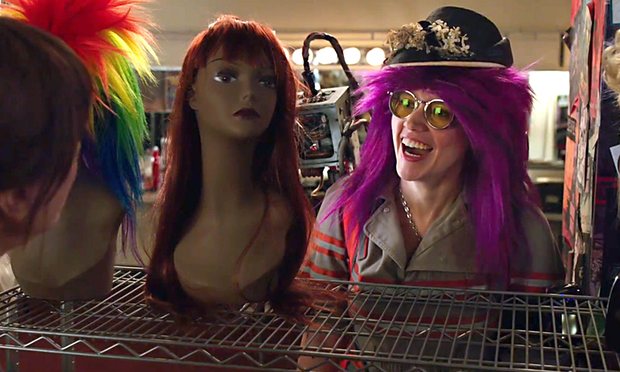
What’s interesting here, though, is that while McCarthy and Wiig anchor Ghostbusters admirably and do most of the heavy lifting in terms of plot development and emotional stakes, it is Kate McKinnon who delivers not only the lion’s share of the laughs but also the one true breakout performance of the film.

In a movie inspired by (kind of sort of) the Book of Revelation, McKinnon is a revelation unto herself.

Anyone who has watched Kate McKinnon on SNL over the past few years knows the raw comedic talent that she brings to the party. From her much-heralded take on Hillary Clinton to her smarmy imitation of Justin Bieber to her white trash alien abductee that forced character-breaking fits of laughter out of her fellow performers (hands-down the best sketch of SNL’s recent season), McKinnon has got the goods in spades.

kmwig

In Ghostbusters, McKinnon gets to spread her wings and experiment with a weird, probing performance that sets her apart from her costars in a way that really elevates the comedy. While McCarthy and Wiig get their laughs through more restrained performances and while Jones stays pretty much in the same box she has constructed for herself since coming onto the national scene, McKinnon gets to freestyle here, and the results are sublime. Like the background musician who suddenly overshadows the lead singer and brings the house down with an improvised guitar solo, McKinnon goes big and goes weird, making such interesting and unconventional choices with her character that you just can’t wait to see what she’s going to do next. More often than not, she gets it right and delivers.

Apart from McKinnon, one of the most notable things about this new Ghostbusters is its complete self-awareness and affection for its predecessor.

A parade of cameos throughout the film serve less as moments of comic inspiration than they do as endorsements from or tributes to the original Ghostbusters’ cast. Despite a flashy appearance by Bill Murray, the most affecting of these is a don’t-blink-or-you’ll-miss-it homage to Harold Ramis—co-writer and co-star of the original—who passed away in 2014 but appears here as a bronze bust outside Erin’s office at Columbia. Casual fans will recognize and appreciate the appearances by Murray, Dan Aykroyd, Sigourney Weaver, the Stay Puff Marshmallow Man, and others; but only the true fan will choke up over that brief glimpse of Ramis’ unmistakable figure standing guard in the hallway. His is the one ghost we hope our squadron of wonderful women warriors don’t blast back into the other dimension.

Star Wars: The Force Awakens

star-wars-force-awakens-official-poster

A long time ago in a galaxy far, far away…

In more than a century of motion picture history, one would be hard pressed to come up with a more eagerly anticipated, massively-hyped film than Star Wars: The Force Awakens. Sure, in recent years, there have been huge franchises that have largely lived up to their billing (Lord of the Rings and Harry Potter and even The Hunger Games are just a few examples). There have been massive best-seller books made into wildly over-hyped movies (Fifty Shades of Grey, anyone?). And there have even been unexpected visits from old friends that we thought we may never hear from again…and ultimately probably shouldn’t have (Indiana Jones and the Kingdom of the Crystal Skull, ugh).

But in today’s age of brute force marketing, corporate cross-promotion, and social media madness, the art of anticipation has reached its golden age.

Thus we have the phenomenon of Star Wars: The Force Awakens, and for some of us, it has been pure heaven.

And when I say “some of us”, let me be precise as to who I’m talking about:

I’m talking about people of a certain age, let’s just say mid-40’s to be kind about it. Men in their mid-40’s, in fact, though certainly there are plenty of women who are equally fanatical. I’m talking about those people who stood in line—in long lines, blocks long—when the original Star Wars came out in 1977 and played at the single-screen movie theater in downtown wherever. Those whose annual St. Nick’s Day stockings and Easter baskets were filled with Star Wars figures. Those who grew up reading books with titles like Han Solo and the Lost Legacy and Lando Calrissian and the Mindharp of Sharu. Those who watched The Star Wars Holiday Special in 1978…and then waited breathlessly—though fruitlessly—for it to air again in the coming years. Those who bragged in our youth that we could recite Star Wars line for line from memory—and could!—and never figured out why we were in our late teens before we had our first date.

Don’t get me wrong: Star Wars fandom absolutely crosses generational, gender, cultural, and just about every other line you can imagine, but there is something special about having been on the ground floor of this particular cultural phenomenon and now seeing new, glorious life breathed into the cherished franchise once again.

The Force Awakens succeeds where the prequels failed (miserably failed, to be sure, though even I will admit that there were some engaging moments here and there) by paying proper deference to and recapturing the spirit of the original trilogy. The new movie just feels like Star Wars, and the return of so many familiar faces and long-lost friends creates the atmosphere of a welcome family reunion.

It takes a while for the reunion to unfold, however.

The Force Awakens takes its time introducing the next generation, as it were (sorry, Trekkies). New heroes, new villains, and even a new adorable robot sidekick dominate the early stages of the film, and it’s all fun and enjoyable to look at, with a capable and engaging young cast that you begin to feel you may just be able to trust with the franchise.

But when Han Solo and Chewbacca burst into the frame for the first time, the movie kicks into proverbial hyperdrive and begins to gather its emotional steam. “Chewie, we’re home,” Han Solo effuses as he re-boards the Millennium Falcon for the first time in ages, and at that moment, every single person in the audience feels exactly the same. We’re home. And that’s when—for some—eyes start to grow misty and perhaps even a single tear rolls down a cheek. And suddenly The Force Awakens begins to soar.

One by one, old friends join the party—human, alien, and machine alike—and one by one it feels as if they had never gone away. Even lines of dialogue—“May the force be with you”—feel like a warm hug from a lost love.

The plot is the plot, which is to say that if you’ve seen Star Wars (I refuse to subtitle it A New Hope, because that’s revisionist), you’ve pretty much seen The Force Awakens. That doesn’t mean that it’s a remake, per se; but the new film tracks much the same as the original did: plot points, character archetypes, and even twists, to some degree. The story and thematic parallels between this film and the original have been much remarked upon in recent weeks and in some quarters roundly criticized, but it is that familiar structure that allows us to remain comfortable and patient as the early introductions play out and we wait for the reunion to come.

Of the veteran cast, Harrison Ford does most of the heavy-lifting as Han Solo, who has matured from scoundrel to curmudgeon in the 30-ish years between Return of the Jedi and this latest installment. And that’s just fine, because even though the original Star Wars trilogy was Luke Skywalker’s story, Han Solo has always been the most fun and intriguing character. It also helps that of all the original cast, Academy Award nominee Ford also has displayed the most serious acting chops of the bunch. So, putting him front and center of The Force Awakens feels like the right thing to do.

Of the newbies, the talented group of John Boyega, Adam Driver, and Oscar Isaac perform admirably enough in roles of varying significance; but it is newcomer Daisy Ridley, as the desert scavenger-cum-quasi-Jedi, who shines most brilliantly. Ridley’s Rey is a revelation of charisma, intensity, authenticity, and flat-out girl power; and if this trilogy in fact turns out to be Rey’s story—as this film strongly suggests—then we have a lot to look forward to in the coming years.

For both the uninitiated (if there truly are any at this point) and the casual fan, The Force Awakens bristles with enough adventure, action, and pure kinetic energy to gloss over the occasional lapses in plot or some of the undeveloped logic of this particular past/future galaxy.

However, for the rest of us, The Force Awakens is far more than an entertaining new film.

It is an emotionally rewarding extension of the mythology of our childhood. It is the welcome erasure of not only Jar Jar Binks, but also of the unnerving racism and cult of petulance that defined the prequel trilogy. It is a movie that makes us feel again like the wide-eyed kids we once were when we sat in a theater and saw for the first time something that we had never even dared to imagine before.

“It’s true,” Han Solo assures us. “All of it. The Dark Side, the Jedi. They’re real.”

That’s how we felt watching Star Wars for the first time nearly 40 years ago, and that’s how this movie makes us feel once again.

The Force Awakens is the movie we’ve been waiting for since 1983, and you come away from it reassured of one thing:

The Force will be with you. Always.
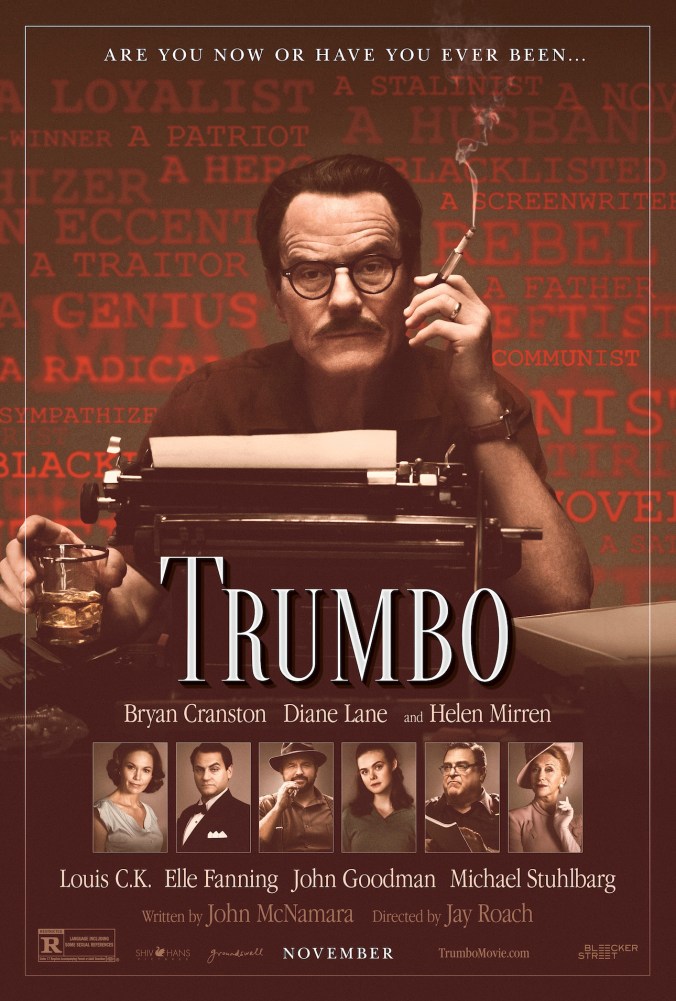
Trumbo

trumboposterThere have been a number of movies in the last year that have been, despite their excellence, particularly hard to watch. Selma comes to mind, as it was difficult not to juxtapose yesterday’s historic struggle for voting rights for African Americans with today’s dispiriting attempts to roll those same rights back and disenfranchise those same people. Suffragette elicited a similar reaction, presenting a striking dramatization of the struggle of women to achieve social justice and independence, released during this year in which women’s rights are under cynical and flagrant attack once again.

The new film, Trumbo, presents a similar intellectual anxiety.

The true story of an Oscar-winning screenwriter blacklisted during the ugly McCarthy era in America, Trumbo stars Bryan Cranston in the title role of Dalton Trumbo, and he delivers a pitch-perfect performance full of wit and rage and fear and indignation.

Trumbo unfolds in an American era in which the country was deeply divided by fear and mistrust, much of it stemming from a mysterious foreign menace that seemed to threaten our way of life…and cynically fueled by opportunistic, craven politicians who saw in that threat the prospect of self-promotion. They questioned the loyalties of people based on the number of vowels or the arrangement of consonants in their last names. Americans whose politics differed from theirs were labeled as traitors. And people were persecuted, victimized, and stripped of their rights despite having perpetrated no wrongdoing nor having committed no crime.

All that resonates as uncomfortably familiar even to those of us who were born long after most of the events of Trumbo take place.

Dalton Trumbo was a communist—which is to say that he was member of the American political party called the Communist Party—and was active and vocal in supporting workers’ rights, unionism, and the First Amendment to the Constitution of the United States. He also was a self-admitted “rich guy”, whose Hollywood success had provided him and his family with plenty to lose when Trumbo decided to stand up the infamous House Un-American Activities Committee. Convicted of contempt of Congress, Trumbo served nearly a year in a federal prison in Kentucky, and when he was released, he was blacklisted from working as a writer.

But Trumbo fought back.

Hollywood has tackled the blacklists before, of course. Robert DeNiro headlined 1991’s Guilty by Suspicion, and George Clooney delivered the consummate prestige picture in 2005, directing Good Night, and Good Luck. Even before those, in 1976, Woody Allen starred in The Front, a simple but effective comedy-drama that had the distinction of being written by (Walter Bernstein), directed by (Martin Ritt), and starring (Zero Mostel, Herschel Bernardi, and Lloyd Gough) a number of artists who themselves had actually been blacklisted.

Trumbo takes a bit from each of those films, combining the personal drama of Guilty by Suspicion with the moral outrage of Good Night, and Good Luck and the dry wit of The Front. The result is a more three-dimensional film that works on multiple levels

The primary joy of Trumbo, though, is watching Bryan Cranston bring to life this strange, unlikely hero. Lurching from moments of thundering indignation to fragile vulnerability and back, Cranston creates a character who is full of contradictions in some ways, but one whose single-minded focus on justice—which just so happens to also mean redemption and security for him and his family—drives him from the opening frames to the closing credits.

The challenge of Trumbo, though, is to embrace and understand that it is neither fiction nor ancient history, and that underneath the drama and entertainment is a moral lesson that can help us understand and interpret the world around us today.

Trumbo would have wanted it that way.