Best of Enemies: Buckley vs. Vidal

poster1

In 1968, politics on television changed forever.

During that year’s Republican and Democratic National Conventions, NBC News and CBS News provided comprehensive gavel-to-gavel convention coverage anchored by straight-arrow newsmen like Walter Cronkite, David Brinkley, and Chet Huntley. ABC News could not afford such lavish coverage, languishing as it did a distant third in the nightly ratings. As one observer put it, they would have been in fourth place, but there were only three networks.

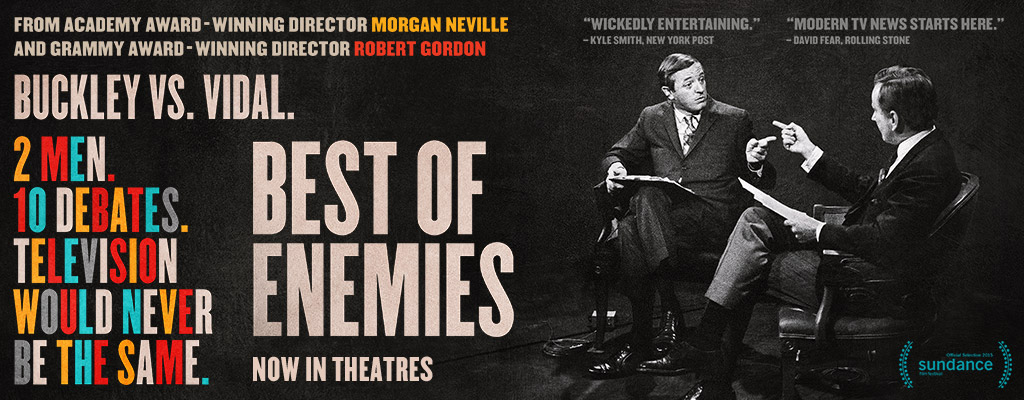
So ABC News offered viewers a different kind of convention coverage. After abbreviated summaries of each day’s convention proceedings, ABC capped the day with one-one-one debates between conservative William F. Buckley, Jr., and liberal Gore Vidal.

Those debates are the subject of the fascinating new documentary Best of Enemies.

Buckley and Vidal were two sides of the same coin. Matter and anti-matter. Fire and ice. But both erudite intellectuals. Both passionate ideologues. Both failed politicians. Both savage debaters.

And both hated each other thoroughly and sincerely.

When ABC News first approached Buckley about participating in the nightly discussions, they asked him if there was anyone he would prefer to debate. He told them anyone other than a communist or Gore Vidal.

William F. Buckley, Jr., was the godfather of the modern conservative movement in America. He founded the magazine National Review, the (other) Bible of American conservatism. He palled around with Ronald Reagan. And he hosted the television show Firing Line, in which he personally debated liberals from all walks of life. Buckley saw Vidal as a symbol of the moral decay of society, genuinely considering him and what he represented to be dangerous to the future of America.

To Gore Vidal, Buckley represented the intellectual façade that masked the ugly machinations of the Republican Party and the conservative movement that had seized control of it. By the time they met in 1968, Vidal was a successful author, screenwriter, and liberal cultural warrior. He looked at Buckley and saw bigotry, paternalism, and elitism, and he suspected that for all of Buckley’s intellectual gymnastics, he was driven—like all conservatives, Vidal felt—by greed and avarice and lust for power.

As Best of Enemies documents, once the debates began, it became clear almost immediately that Buckley and Vidal were largely uninterested in debating the events of the day and only slightly more interested in debating the broader policy questions that would shape the coming Presidential election. Instead, their aim night after night became to ridicule the other, to undermine and attack each other’s intellectual and moral foundations, and to completely discredit not only each other, but by proxy the ideological movement that the other represented.

The documentary demonstrates how Vidal came to the debates armed with opposition research, scripted and rehearsed “spontaneous” retorts, and a strategy to grate, irritate, and bait Buckley in order to “expose” him to a mainstream, national audience.

And his strategy worked.

Over the course of the debates, snide asides became pointed barbs, which evolved into personal insults, which exploded into a dramatic, riveting exchange in which Vidal taunted Buckley as a “crypto-Nazi” and Buckley spat back his infamous, defining invective: “Now listen, you queer, stop calling me a crypto-Nazi, or I’ll sock you in your goddamn face and you’ll stay plastered.”

WILLIAM BUCKLEY;GORE VIDAL

The live-TV exchange was jaw-dropping at the time, and nearly 40 years later, the documentary’s juxtaposition of images of the trembling-with-anger Buckley and the smug, self-satisfied, grinning Vidal completely and utterly enthralls.

At the heart of Best of Enemies, though, is not just the story of two men, ten debates, and a few weeks in 1968.

The Buckley-Vidal debates set in motion a change in televised political coverage that has never been reversed and that now defines the way Americans consume their political news…and really their politics in general.

ABC’s ratings soared during the 1968 Party Conventions, and never again did any network provide full gavel-to-gavel convention coverage. Commentary began to dominate political news, later giving rise not only to the take-no-prisoners formats of broadcast network shows like Meet the Press, cable programs like Crossfire, and even whole networks like Fox News and MSNBC.

The seeds of the Buckley-Vidal debates flowered well beyond politics, in fact. Today, television, radio, and internet pundits shout angrily at each other daily about the latest sports news, the direction of the stock market and the economy, and even about the latest foibles of the least important celebrities.

Even more significantly, though, the glimpse into the Buckley-Vidal debates offered by Best of Enemies is striking in its implications for how people who disagree today feel not only about the issues that they debate but also about the people on the other side of the aisle. It is no longer enough to discredit someone’s argument or to rhetorically triumph through logic or reason. Rather, victory can only be achieved by discrediting the other guy, the other Party, or the other movement. Absent the ability to prove the supremacy of any particular ideological value beyond a reasonable doubt, it is much easier to attack motives, to question morals, and to damn messengers.

None of that, of course, can entirely be traced to the Buckley-Vidal battles, but that brief moment in political history—and the window into it provided by Best of Enemies—certainly offers an absorbing look at what we have all become.

As for Buckley and Vidal themselves, Best of Enemies submits that in two lifetimes of tremendous achievement, their battles in 1968 were defining personal moments.

For decades afterward, Vidal treasured the fleeting victory of that explosive outburst from Buckley, which conversely haunted the conservative warrior until his death in 2008.

A death, incidentally, that Best of Enemies suggests Vidal—who died four years after Buckley—delighted in, if only because it gave Vidal the last word.

Trainwreck Stays Pretty Much on the Tracks

Trainwreck_poster

It takes some guts to call a movie Trainwreck.

Let’s face it, if the movie turns out to stink, the reviews—or at least the headlines—pretty much write themselves. But thankfully the new Amy Schumer comedy mostly stays on the rails throughout, and despite being a surprisingly paint-by-the-numbers post-modern romantic comedy, it provides plenty of laughs and a solid vehicle for Schumer’s first major film role.

I will confess up front to not being a fan of the hit (or is it just hip?) comedy series Inside Amy Schumer…not because I don’t like the show, but because I really haven’t seen it. However, the bits and pieces I have caught of her skits and standup on social media and via various podcasts confirm that she is a true comedic talent. Her subversively incisive feminist takes on modern culture, gender roles, and 21st century womanhood put her into the Stewart-Colbert category of cultural commentator, with the rare ability to unpack an idea or issue completely, lay it bare, and expose it for all its absurdity and hypocrisy. All while making us collapse in fits of laughter.

That’s why, for all its laughs, Trainwreck ends up to be just a bit of a disappointment.

Amy Schumer plays Amy, a young-ish New York career gal frozen somewhere between crazy party girl and successful adulthood. By day she writes for a men’s magazine called S’Nuff, and by night she embraces a bacchanalian lifestyle that generally ends with some sort of disastrous sexual encounter…either with a random stranger or her own muscle-bound, sexually-confused boyfriend. When we first meet Amy, you see, she is just a young girl, and her father is trying to explain to her and her sister why he is leaving the family. Both girls have favorite dolls, he explains, but that doesn’t mean they don’t want to play with other dolls, right? After running down all the possible doll types that they—or he—might want to play with, he sums things up by making the girls repeat the lesson over and over again: “Monogamy isn’t realistic.” And that remains Amy’s mantra until she falls for a successful sports surgeon (a terrific post-Saturday Night Live Bill Hader)…and you can pretty much paint in the numbers from there.

Trainwreck does have plenty of highs.

Schumer is terrific from start to finish. Her writing and portrayal of a young woman who is both comfortable in her own skin and still starting to recognize that maybe it’s time to grow up is legitimately spot-on. And her hilarious sexcapades-gone-wrong are downright hilarious. At the same time, Trainwreck focuses as much on Amy’s family relationships—primarily between her and her sister and father—as on her romantic quest, delivering a handful of truly touching moments and one full-on tear-jerker.

But there are just too many lows.

As Hader’s best friend, LeBron James plays a pretty funny version of himself: fanatical about Cleveland, hopelessly romantic, and outrageously cheap. But he really can’t act. And when the film feels the need to expand its universe of sports-personalities-as-themselves by bringing together James, Chris Evert, Marv Albert, and Matthew Broderick (what?) for a key late scene, the result is, well, a total train wreck.

More than the comedic misses, though, the ultimate trajectory of the movie and its sappy conclusion are a bit of a head-scratcher.

All that said, it’s probably unfair to judge Trainwreck on anything other than what it is.

Trainwreck is a comedy, and it’s funny.

And that’s good enough for a Friday night.

It’s Hard to Hang with The Gallows

gallowsposter

In 1996, the movie Scream famously articulated the “rules” you needed to follow in order to survive a horror movie of that era. Nearly 20 years later, I would humbly revise those rules with some suggestions as to how today’s teens might avoid finding themselves trapped in a horror movie altogether.

  1. First and foremost, if your high school drama club stages a play and the lead actor dies on-stage under highly mysterious circumstances, do NOT star in a revival of the play, on the same stage, twenty years later.
  1. If by chance you violate rule # 1 and do star in the revival of the play, do NOT sneak into your school late at night the day before the play is to open—twenty years to the day after the tragic accident—and do mischievous things on the stage.
  1. And finally, and I can’t stress this enough, but if you do ignore rules # 1 and # 2, do NOT—and this is very, very important—do NOT make sure you have multiple video cameras running at all times in order to provide a seamless, minute-by-minute account of all the horrible things that follow.

Ironic, actually, that rule # 3 should include the word “horrible”, because as it turns out, each and every one of my three rules are broken in the horrible new found-footage horror flick called The Gallows.

Found-footage horror films have existed for years, long before they were made famous by The Blair Witch Project, the success of which was less about pioneering a new subgenre and more about its ingenious marketing effort. Since The Blair Witch Project, however, the found-footage approach has too often been not a creative choice, but rather an excuse for poor production values, bad acting, and lack of vision.

To be sure, there have been some top-notch found-footage films in recent years. Barry Levinson’s The Bay was interesting if not all that scary. Norway’s Trollhunter was creative, thrilling, and fun. And the anthology V/H/S hit hard and fast and was legitimately terrifying.

But for every V/H/S, there have been a dozen films like the promising but dreadful The Houses that October Built, The Amityville Haunting, and The Frankenstein Theory. (Bluntly, if The Frankenstein Theory had actually been an honest-to-goodness documentary, and at the end of the documentary you would actually see actual, verifiable footage of a REAL-LIFE, man-made monster walking the earth…this movie would still be all but impossible to sit through.)

Actually, make that a baker’s dozen and add The Gallows to the ledger on the dreadful side.

At the start of The Gallows, we see home video footage of a school production of a play called “The Gallows” (that’s the name of the movie!), shot from the back of a typical high school auditorium. In hushed whispers, a mom and dad talk over the action and roadmap out the proceedings for us: complimenting the fine construction work on the set’s gallows and obliquely referring to some mysterious “last minute change” that can only foreshadow disaster. (If you put these two on an airport runaway with a couple of flashlights, their pinpoint guidance would keep all the planes running on time, no doubt.) Of course, disaster does strike, and after little Charlie slips the gallows’ noose around his neck, something goes wrong and little Charlie dies. Turns out the construction work on the gallows was not quite as good as they thought…or maybe just a bit too good?

Fast-forward 20 years, and a new crop of theater students is in the final day of rehearsals for a revival of “The Gallows”. Due to a remarkable collision of convenient antics, longings, and lazy plot devices, four of them wind up locked in the school at the witching hour, and before long, the sinister, ghostly Hangman starts to stalk them.

hangman

The Gallows manages to conjure up one or two brief—very brief—unsettling images. And it manages to construct a few—very few—jolts and moments of suspense. But for a movie that clocks in at an economical 81 minutes, it is somewhat shocking how much time drags on at the beginning of this movie before anything interesting (and that’s a relative term here) happens. Despite featuring twice the number of writers and directors here as usual—Travis Cuff and Chris Lofing share both duties—The Gallows delivers less than half the scares. And that’s being generous.

In the end, the victims of the Hangman turned out to be the lucky ones: they didn’t have to stick around all the way to the end of The Gallows.

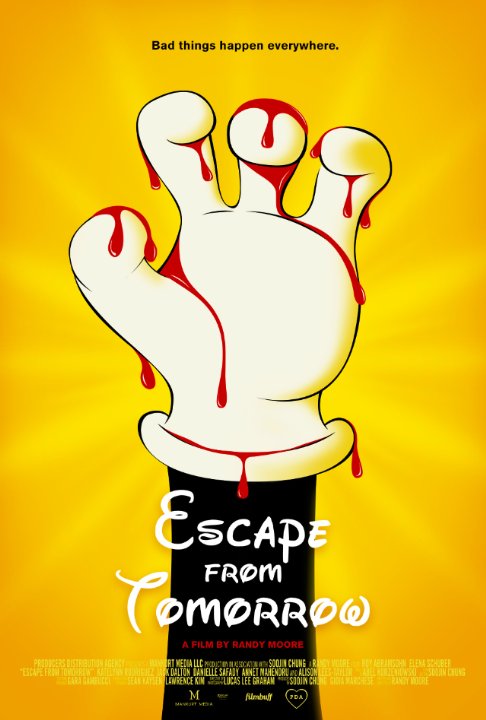
Escape from Tomorrow: Brilliant Filmmaking, Terrible Film

escapeposter

What do you get when you combine awful characters, awful scripting, and awful performances…and plop them down smack dab in the middle of the happiest place on earth? You get the incoherent, practically unwatchable—but yet maddeningly fascinating—Escape from Tomorrow.

First released in late 2013 but finding some (though very little) footing in theaters throughout 2014, Escape from Tomorrow is now available on DVD, Blu-ray, and digital (currently streaming on Netflix).

The film itself is largely unsuccessful in just about every way that you can consider, but there is a legitimately great story behind Escape from Tomorrow.

Ambitiously directed by first-time filmmaker Randy Moore, Escape from Tomorrow was shot over the course of roughly twenty-four days, guerrilla-style, at Walt Disney World and Disneyland…without receiving permission from the Walt Disney Company.

This approach required tremendous secrecy and creativity. Without the ability to use any lighting equipment, for example, months of planning went into the shoot to ensure that outdoor scenes were shot when the sun was at just the right point in the sky. The actors and filmmakers used their iPhones to review scripts. Portable audio recorders were strapped to the actors and left running all day. Footage was shot using video mode on Canon digital cameras so that the filmmakers would look like typical tourists snapping photos of their vacation. And the number of takes allowed for each shot and scene were limited in order to avoid suspicion from park employees and other visitors.

That is inspired, daring filmmaking that simply boggles the mind.

The movie itself, however—billed as a horror fantasy—does not live up to the legendary tale behind it.

family

A family from Bristol, Wisconsin (yay Wisconsin!) is winding down their vacation at Walt Disney World, when strange things begin to happen, primarily to the unhappy and unlikeable (more on this later) dad, Jim. After waking up one morning to a phone call from his boss telling him that he is losing his job, Jim enters the final days of the family vacation in an emotionally precarious state. Things only get worse when he begins to have disturbing, startling visions on the various Disney rides, and the minor trials and tribulations common to a family day at a theme park—hungry kids, scraped knees, closed rides—begin to take on ominous, threatening overtones.

Is Jim going crazy, or are there some sort of evil forces at play?

The problem with Escape from Tomorrow is that you simply don’t care.

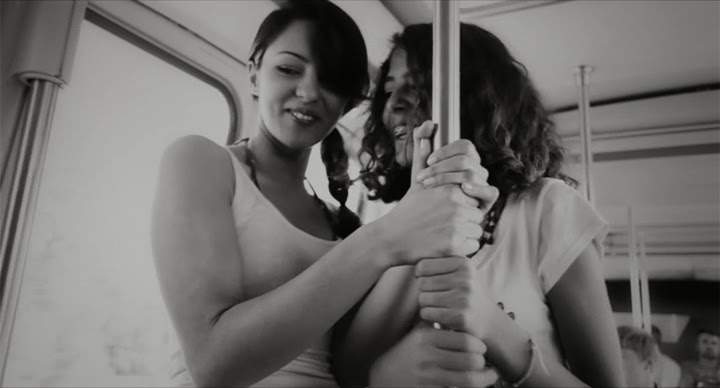
Start with the family itself. They are all—parents and kids alike—thoroughly unlikeable and uninteresting. The kids go from emotionally dead to whining to screaming in less time than it takes to cannonball into an overcrowded resort pool. The mother is a caricature of the worst kind: a nagging, badgering shrew who is emotionally abusive toward her husband but a protective mother hen to her kids…right up to the point when she slaps her daughter for really no good reason. And dad Jim is not a character so much as a lecherous cliché. He follows two underage Parisian girls around the parks, leering and fantasizing over them like a low-rent Nabokov villain. He guzzles booze to the point that he ends up puking over the side of the boat on Epcot’s Gran Fiesta Tour. And he loses track of his kids multiple times as he stumbles through his narcissistic journey. Father of the Year material he ain’t.

jimfranch-chicks

It certainly does not help that the acting fails almost entirely across the board. While nobody in the cast stands out, Roy Abramsohn’s performance as Jim weighs the film down significantly. Asking Abramsohn to carry the film may well have been an unfair ask in the first place, considering his film and TV credits prior and subsequent to Escape from Tomorrow are almost entirely devoid of proper nouns. His recent roles include Subject #1, Reporter #2, Supervisor, Reporter #2 (different show!), Male Reporter, Man, Reporter #1, and Date #2. I could go on. Here, Abramsohn stammers, double takes, and grimaces through most of the movie, demonstrating that subtlety and nuance of a beer belch during a church service.

Even the bad acting, though, might have been palatable if the film itself were more interesting, but Escape from Tomorrow substitutes pretense for intelligence. The film presents itself (and it may even believe it) as having something profound to say, but it really doesn’t. American consumerism suffocating the family unit? No, not really. Corporate malfeasance disguised as good-natured family fun? Nope, that’s a miss. Male castration through marriage, fatherhood, and professional failure? Close, but no cigar.

Despite the audaciousness and ambition of the production, Escape from Tomorrow just isn’t very good. In fact, it’s downright bad. And it’s a shame. When you think about all the work, all the planning, all the ingenuity it took to make this movie, maybe they should have just gone the extra mile and made a good movie.

The making of Escape from Tomorrow will be a legendary story told in film schools and movie clubs for years and years to come, long after the movie itself is forgotten.

But in the end, Escape from Tomorrow is a just movie about four people who hate each other, and it is hard to blame them. After spending just 90 minutes with them, you will too.

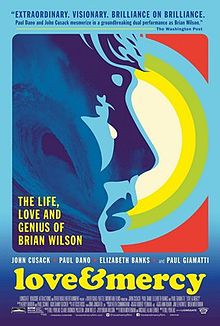
Love & Mercy: Bad Vibrations, Great Movie

Love_&_Mercy_(poster)

I’m not a musician. I don’t play an instrument, don’t read music, and can’t really carry a tune. I don’t pretend to understand music theory or philosophy. But I do know how music gets under my skin, touches me, and powerfully affects me in ways that nothing else does.

And I know that the creative force behind some of the songs that do just that is Brian Wilson.

Wilson—the legendary co-founder, songwriter, and force-of-nature behind the Beach Boys—is the subject of the quasi-new, quasi-biopic Love & Mercy.

Unlike traditional musician biopics, Love & Mercy—released in 2014 but distributed widely just this summer—does not attempt to chronicle Wilson’s entire life and career, but rather focuses on two relatively narrowly-defined periods of Wilson’s life: the 1960’s and the 1980’s. In the earlier period, Wilson was producing the Beach Boys’ masterwork album, Pet Sounds, and beginning to struggle with the serious mental illness that eventually derailed his career and his life. In the later period, Wilson was falling in love with his second wife and would-be-savior—Melinda Ledbetter—while psychologically imprisoned and controlled by shady psychotherapist Eugene Landy.

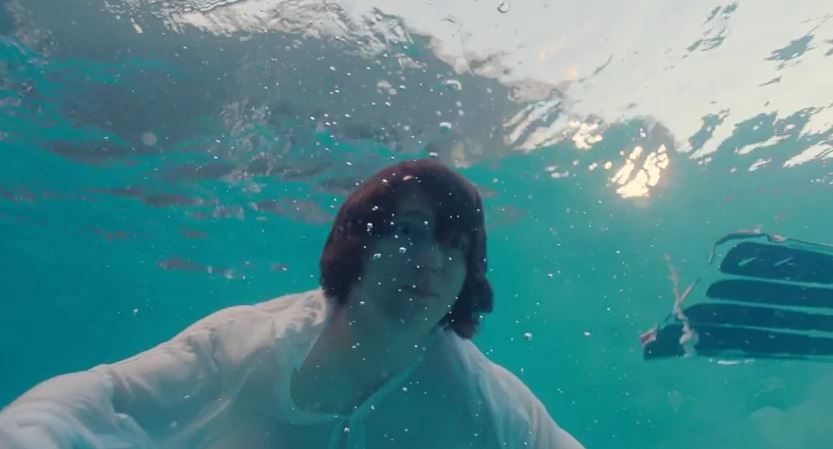
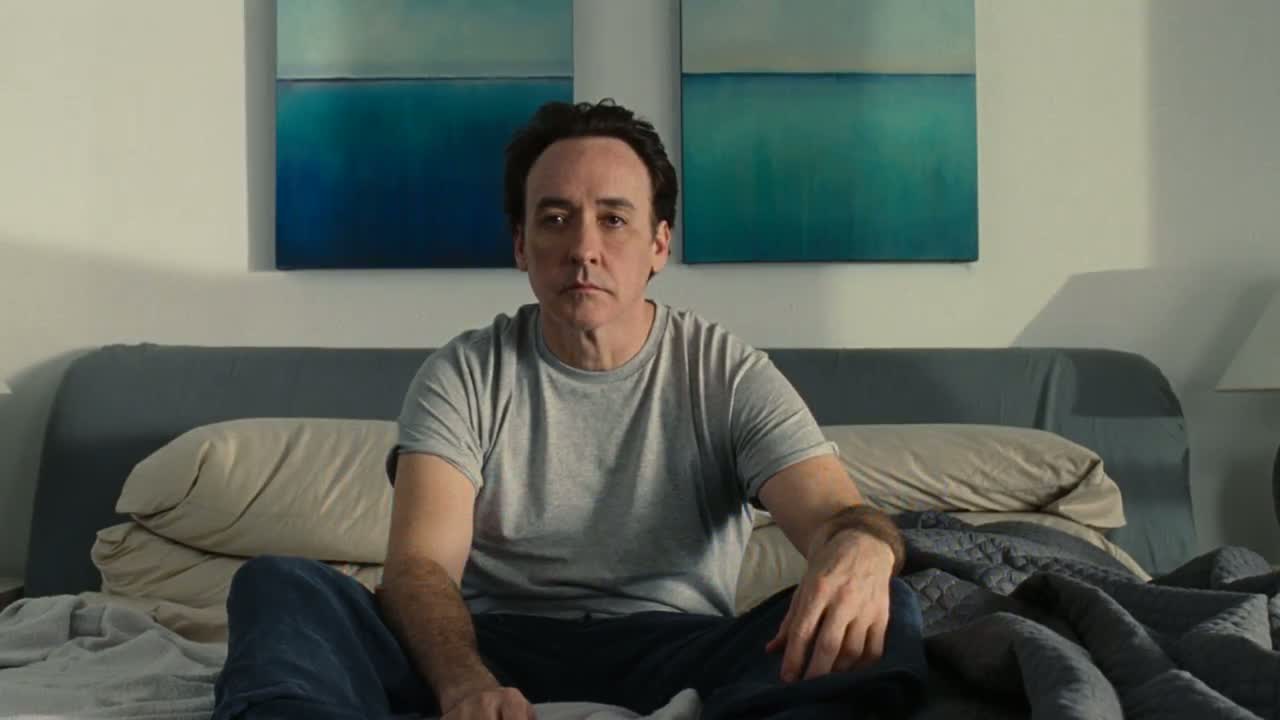
Love & Mercy alternates back and forth between the two periods in Wilson’s life, with Paul Dano portraying the younger, faltering Wilson, and John Cusack filling the role of the older, broken Wilson. The unconventional approach—two different adult actors playing the same character at different points of his life—works in unexpected and riveting ways. After two decades of struggle with debilitating mental illness, drug abuse, and family turmoil, the fragile, dependent Wilson of the 1980’s indeed seems to have been a completely different man than the energetic, dynamic Wilson of the Pet Sounds era. Dano and Cusack famously did not coordinate their takes on Wilson and barely even met before or during the film’s production, and as a result their individual portrayals of the man are crafted and shaded in their own unique ways. And both shine.

dano2cusack

The always-reliable Dano disappears into his role, imbuing it with the same bursts of intensity and nuance that brought him critical acclaim in Little Miss Sunshine and There Will be Blood. Dano illuminates the screen as young Wilson, bringing a manic joy to the scenes in-studio as Wilson feels his way through Pet Sounds, and equal parts vulnerability and independence in the one-on-one emotional encounters with his father. In one early scene, Dano’s Wilson sits at a piano and plinks through his new composition God Only Knows—a song that Paul McCartney would later call his favorite song of all time—for his father, whom the Beach Boys had already fired as their manager. Desperate for his father’s approval but resolute in the rightness of his musical vision, Dano sets the table for the parallel relationship that Wilson would struggle with in later years with Landy.

It is Cusack, however, who is a bit of a revelation here, eschewing the easy charm that has defined the bulk of his career and hollowing out his character to its raw, desperate core. It’s not that Cusack outperforms Dano, per se, but rather that we see a performance from Cusack unlike any in his career so far. It is personal, powerful, and delivers a handful of heart-breaking moments that linger well beyond the closing credits. When Cusack’s Wilson meets Ledbetter and slips her a handwritten note that says simply “Lonely, Scared, Frightened,” it is a disarming and painful cry for help that Cusack spends the rest of the film echoing.

banks

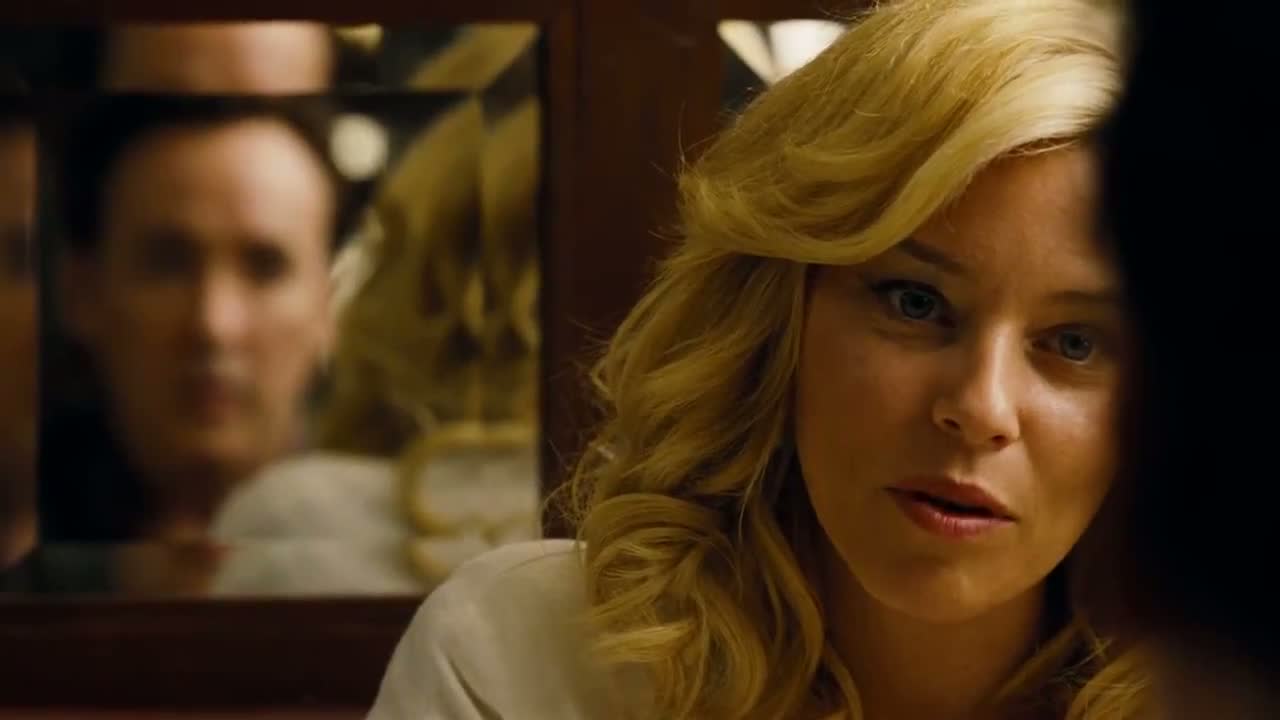
Like Cusack, Elizabeth Banks surprises as Cadillac-saleswoman-turned-guardian-angel Melinda Ledbetter. When she comes across Wilson in her showroom, she circles him warily, unsure what to make of the emotionally reclusive teddy bear that he appears to be. Banks especially shines in her scenes with Paul Giamatti’s Landy, whose relationship with Wilson—by all accounts—was somewhat more complex than the one sketched out by the movie, but who here fills the role of villain with relish. At first, Banks’ Ledbetter defers to Landy. Later, she probingly challenges him. Finally, determined to break his hold on Wilson, she goes fully to battle with Landy and fills the screen with her strength and determination. Love & Mercy’s odd release schedule will likely do it no favors come awards season, but even in an acting showcase such as this, Banks’ performance stands apart and may be the one most likely to gain recognition down the road. If nothing else, it elevates Banks to a new level as a leading dramatic actress.

In a film that splits its main role between two actors, though, it seems only fitting that a third Brian Wilson—the real Brian Wilson—be introduced in the film’s closing moments. As the credits role, we see Brian Wilson himself in close up, at a piano, delivering a concert performance of his song Love and Mercy. The delicate, gentle strains of the song from the man himself offer a comforting, redemptive punctuation to the film. Brian Wilson still struggles, still hears the voices in his head, and still wrestles with the demons of his life.

But Brian has his music. He has Melinda. And he has survived.

Jurassic World: Bigger, Faster, Louder

jworld

Those of a certain age will remember the spectacle of seeing Jurassic Park on the big screen in 1993. The hype, the anticipation, and ultimately the payoff: the moment when the skeptics and scientists first look out over the park and see a field full of living, breathing dinosaurs. It was honestly awe-inspiring. It may seem silly today, but like those first visitors to the fictional Jurassic Park, real-world audiences were seeing something that they had never seen before.

The deployment of visual effects in Jurassic Park—not just the game-changing CGI but also its seamless blending with more traditional animatronics and live actors—was revolutionary. Think about the simplistic dinosaur effects that had come before: the prehistoric creatures of King Kong (1933), One Million Years B.C. (1940), Journey to the Center of the Earth (1959), The Lost World (1960), The Land that Time Forgot (1975), Baby: Secret of the Lost Legend (1985), TV’s Land of the Lost (1974-77)…or even the pseudo-dinosaur men-in-suit approach of Godzilla (1954) and his descendants. Nothing that came before could prepare audiences for what they would see in Jurassic Park.

For the first time ever, the bones in the museum grew flesh and moved. The lost creatures that had fueled our imaginations since childhood were there, in front of us, interacting with real people. All of a sudden, cinematic dinosaurs seemed real.

When Sir Richard Attenborough’s John Hammond intoned his breathless “Welcome to Jurassic Park”, it marked a new era in film.

Twenty-two years and hundreds upon hundreds of CGI dinosaurs later, Jurassic World suggests that the new era has become passe’.

Apparently, twelve years after the disaster of the original film (and ignoring the existence of its two sequels), the dinosaur park finally opened as Jurassic World on the infamous Isla Nubar, and it has become an international sensation. We join the action ten years on, at a time when Jurassic World’s brain trust has decided that the only way to protect its market share (from what is never really clear) is to introduce new attractions: in this case, an ill-conceived genetic mishmash dubbed Indominus Rex that is bigger, badder, and more terrifying than any dinosaur that Mother Nature could come up with on her own.

Believe it or not, Indominus gets loose, and hijinks ensue.

Are there kids and scientists and heroes and villains? Sure. Are there plot twists and third act surprises? Sort of. Does any of it matter? Not really.

This is a movie about dinosaurs, dinosaurs, and more dinosaurs. Everything else is a distraction.

The whole bigger-badder-more-terrifying thing has been much remarked upon since the release of Jurassic World, primarily because the movie is so self-conscious about it. When Bryce Dallas Howard, as the park’s operations manager, explains to a group of investors that “just” dinosaurs isn’t enough anymore—focus groups have told them that consumers expect something bigger and more exciting—the scene might as well have cut away to a flashing neon sign saying “WE’RE TALKING ABOUT THE MOVIE BUSINESS!” Then again, one shouldn’t expect subtly from a movie about a genetically-engineered sociopathic dinosaur.

The shame of it, though, is that the filmmakers actually got the theme wrong. It’s not that audiences are demanding “bigger, faster, louder, better,” as Jurassic World director Colin Trevorrow suggested in one interview. It’s that Hollywood has found that “bigger, faster, louder, better” is simply easier to make than “original, interesting, challenging, smart”. It’s an industry that thinks a $20 million movie is more of a risk than a $200 million movie, because at least with the latter they have a formula to follow: formulaic scripts, formulaic characters, formulaic effects, and formulaic marketing. So, in a sense, perhaps it is a self-fulfilling prophecy. If everything is a formula, then really the only way to stand out from the crowd IS “bigger, faster, louder”.

But that doesn’t necessarily mean better.

The original Jurassic Park carved out its place in film history because of the “wow” factor and its industry-changing visual effects. But that’s not what made it an effective movie that stands up to multiple viewings. Jurassic Park is a taut, suspenseful thriller with strong characters, terrific acting, and a world-class director at the top of his game. That film’s climactic kitchen scene—the velociraptors stalking the kids in the theme park’s pantry—remains one of the great suspense scenes ever put to film. The movie still holds up terrifically today, 22 years later.

Jurassic World will not have that kind of shelf life.

Trevorrow, himself—who had exactly one feature film credit to his name prior to Jurassic World—got his start by way of “original, interesting, challenging, smart”. His feature debut, Safety Not Guaranteed, is a little film about a trio of magazine employees who pursue a story about a guy who places a classified ad seeking a companion for time travel. If Jurassic World is a gargantuan T-Rex, then Safety Not Guaranteed is a tiny little baby pigeon, but it is absolutely terrific. Somewhere along the way from tiny to titanic, though, Trevorrow lost his way. (That is, if Jurassic World’s $524 million opening weekend can be considered losing his way. Safety Not Guarantee, by contrast, grossed just under $100,000 its first weekend.)

None of this is to suggest that Jurassic World is a film without merit.

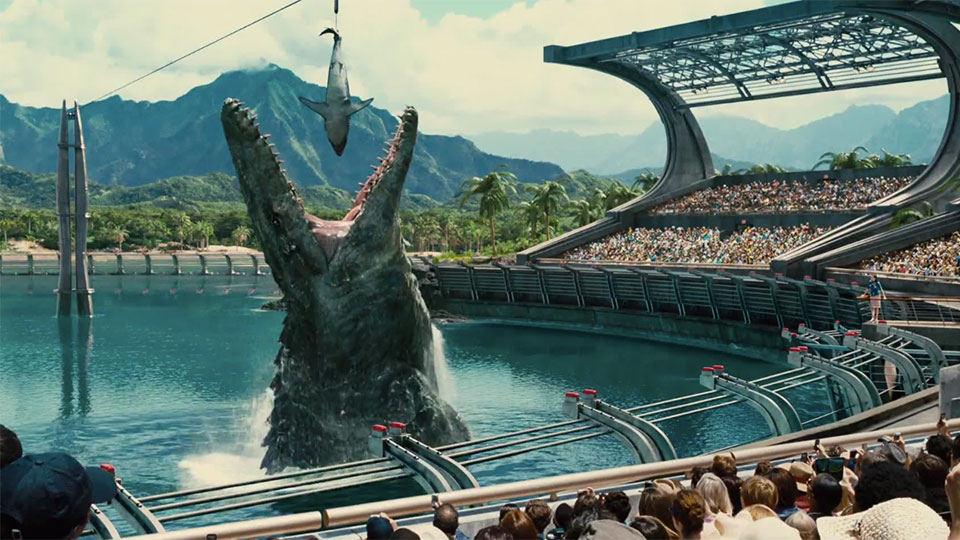
The early scenes, especially, chronicling a day-in-the-life of a dinosaur theme park, are legitimately inspired. From the crowds pouring through the gates to the wonder in the eyes of the kids seeing their first dinosaurs, you really get a sense of what a theme park like this would actually be like. And it’s awesome. You may not even realize anything is different when you see the IMAX theater, the food franchises (Margaritaville, anyone? Ben & Jerry’s?), and gift shops. Pretty standard stuff. But then you take your kids to the Gentle Giants Petting Zoo and saddle up for a ride on a triceratops. You take a self-guided kayak trip down dinosaur dwelling river ways. And you settle in for a riveting Sea World –esque water show (didn’t these guys see Blackfish?) on steroids…climaxing with a gigantic, 60’ long Mosasaurus leaping out of the water to munch a shark hanging from a steal hook. Eat your heart out, Shamu! Jurassic World’s Jurassic World is truly a sight to behold, full of spectacle and clever imagination. (Check out the park’s fully fleshed out Website at www.jurassicworld.com.)

Considering the fact that there have been interminable lines forming outside Disney’s It’s a Small World ride since it first debuted at the 1964 World’s Fair, somehow it seems unbelievable that Jurassic World patrons have already grown “bored” after just ten years.

The again, one patron, at least, grew bored with Jurassic World in less than two hours.

But maybe that’s just me.

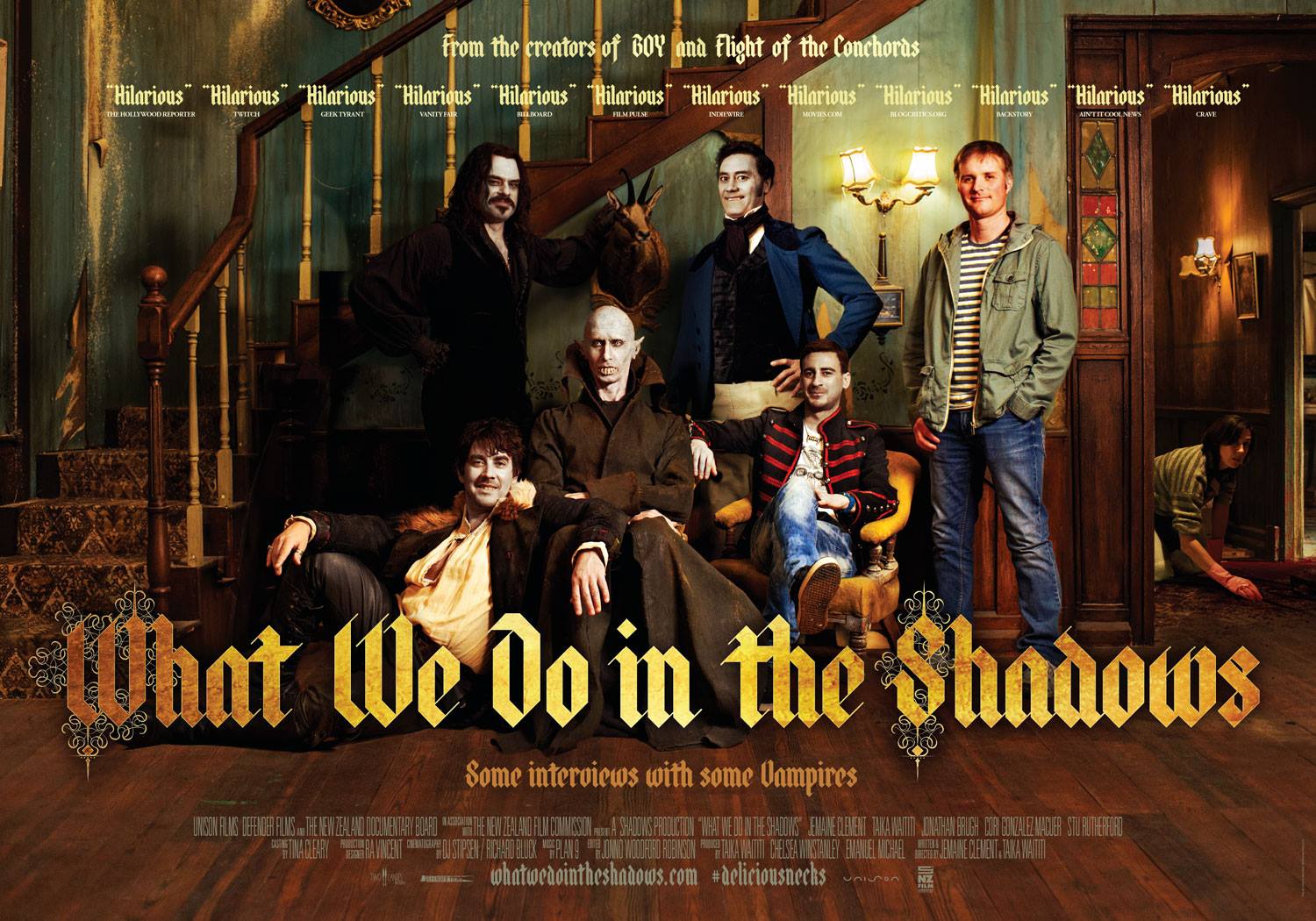
Laughing at the Shadows

shadows-quad

“There’s tension in any—any—flatting situation.”

Wise words, indeed, but then wisdom does come with age. And at 862 years old, Jermaine Clement’s vampire Vladislav—from the pitch-perfect What We do in the Shadows—has had centuries to hone his personal flatting philosophy.

The particular flatting situation at the heart of What We Do in the Shadows (now streaming at a variety of venues) involves four undead roommates who share a gothic old house in Wellington, New Zealand. Seemingly mismatched—there’s the swashbuckling Vladislav, the prissy Viago, the chore-slacker Deacon, and the crotchety 8000-year-old Petyr—these vampires bicker and snarl at each other from time-to-time, but have clearly fallen into an easy, pleasant co-existence. They’re friends. But their comfortable arrangement faces significant challenges when Petyr turns their servant’s vacuous ex-boyfriend Nick into a vampire. Nick promptly moves in with the boys and upsets the whole dynamic. Lucky for us, there is a film crew from the New Zealand Documentary Board on-hand to capture the evolving conflict.

Think MTV’s Real World but set in Victorian England but actually modern-day Wellington—so maybe a sort of pseudo-Victorian Wellington?—and you will have a good sense of what to expect. Together, the vampire pals discover the internet and the wonders of video chatting. They negotiate the exclusive Wellington club scene. And when they want to keep a low profile, they eschew flying across the countryside and instead take public transportation out for their night on the town.

Clement and Taika Waititi (as Viago) both pull triple-duty here: co-starring, co-writing, and co-directing. Although American audiences will know Clement best from two hilarious seasons of Flight of the Conchords (well, one hilarious season, and then a follow-up), their previous cinematic collaboration was 2007’s Eagle vs. Shark. In that film, Clement starred and Waititi wrote and directed. Where Eagle vs. Shark was charming but uneven, their work on What We Do in the Shadows represents much more confident, effective movie making.

Their script is sharp. Their cast—from the central characters to the walk-on parts, especially Rhys Darby as the alpha male among a pack of personally-conflicted rival werewolves—is spot-on. And what it lacks in story the movie more than makes up for with intelligent, character-driven humor, terrific visual gags and asides, and an obvious affection for the classics of the horror genre.

What We Do in the Shadows succeeds due in large part to that palpable love and appreciation of horror classics. Its humor may be modern, but its roots and inspiration burrow through more than a century of classic horror cinema. More Young Frankenstein than Scary Movie 5, Shadows’ affectionate take on the horror comedy offers equal parts satire and homage, with dashes of genuine melancholy and dread thrown in for good measure.

That tone represents a welcome departure from the current trend in horror comedy.

Comedy and horror have been kissing cousins since the early days of cinema. Moments of humor have been the go-to safety valve that horror filmmakers use consistently to relieve audience tension and to provide a break from the suspense and terror. But then a subgenre emerged and fused the horror film with the movie comedy.

The dark humor of The Bride of Frankenstein, for instance, eventually evolved into movies like An American Werewolf in London, The Evil Dead 2, and Re-Animator: horror movies first but with a wildly comic spin at the same time. Early full-throated horror satires like The Cat and the Canary, The Ghost Breakers, and Abbott and Costello Meet Frankenstein (and the Mummy, and the Killer Boris Karloff, and on and on) eventually became Young Frankenstein and Ghostbusters.

But then something changed.

Over the past 20 years or so, any genuine appreciation of the genre has essentially disappeared from the horror-comedy. With the rare exception (say something like Shaun of the Dead or Zombieland), the modern horror-comedy either wants you to know how very hip and smart it is…or doesn’t really care how stupid it becomes.

Scream introduced the concept of “meta” into the horror genre, primarily by telling its audience over and over and over again just how “meta” it was. It is unclear if more damage was done in Scream by knife-wielding maniacs or by the main characters (and filmmakers, included) breaking their own arms by incessantly patting themselves on the back. That is not to say that Scream is a bad movie or that “meta” horror is all bad. Funny Games, Behind the Mask: The Rise of Leslie Vernon, and Cabin in the Woods are all interesting, fun (well, Funny Games isn’t fun at all), creative takes on “meta” horror.

At the other end of the spectrum is the brain-dead horror-comedy. The Wayans brothers are not entirely to blame here, but they have certainly done more to dumb-down the genre than any family in the history of cinema. Their Scary Movie(s) and Haunted House(s) take the lowest common denominator and somehow still manage to divide it by two. The audience isn’t so much expected to actually find these movies funny but simply to recognize that they are MEANT to be funny, and that is apparently good enough for them.

In that context, What We Do in the Shadows is more than a breath of fresh air.

It’s an instant classic.