Ghostbusters

Ghostbusters_2016_film_poster

Ghostbusters was a preternatural hit back in 1984. It raked in $242 million dollars in gross domestic box office, established Bill Murray as a bonafide movie star, and was—for people of a certain age (cough, cough)—a legitimate cultural touchstone.

Released more than 30 years later, the remake—or reboot, if you prefer, considering there are likely to be plenty of sequels to come—does not rise to that level, but it is still fast-paced, consistently funny, high-quality summer entertainment.

The year is 2016, and New York City is grappling with an unusual spike in supernatural activity. Estranged academic collaborators Abby and Erin (Melissa McCarthy and Kristen Wiig) find themselves reunited by circumstance to investigate a local haunting, and they come face-to-face (and then some) with a malevolent apparition that more or less proves their metaphysical theories. When the video of their apparently-phantasmagoric encounter hits YouTube, both are fired from their academic posts—Erin from Ivy League Columbia University and Abby from a low-rent NYC technical college—leaving them little choice but to go into business for themselves as private paranormal investigators. Abby brings her assistant Jillian (Kate McKinnon) along with them, and eventually they add a fourth ghostbuster, Patty (Leslie Jones), and an oblivious-but-hunky secretary, Kevin (Chris Hemsworth), to their team. There is a modicum of political intrigue along the way and a forgettable human villain to be reckoned with, but mostly these gals spend the rest of this movie battling rampaging spirits from the great beyond.

Lest we forget the embarrassing, (let’s-just-call-it-what-it-is) misogynistic uproar over casting this film with four women instead of four men, Ghostbusters has been mired in hate-spewing social media controversy for the better part of the last year. A certain segment of the movie-going public found itself positively aghast that Ghostbusters 2016 would continue to prosecute the proverbial “war on men” that began when The Force Awakens planted a female character at the center of a galaxy far, far away. Angry trolls everywhere lashed out from their parents’ basements and filled online comment sections and social media timelines with vitriolic screeds of hate and disappointment, demanding that the filmmakers give them an XY reboot instead of the soft, fuzzy XX version that they were sure they’d get.

The irony of that, of course, is that in today’s Hollywood there is no comedian–male or female–with more box office clout than Melissa McCarthy, so why wouldn’t she headline a high-profile summer comedy? Add in Kristen Wiig—who single-handedly kept Saturday Night Live afloat for several seasons in the 2000’s and also headlined a little $170 million hit comedy called Bridesmaids—and you’ve got some serious juice behind this movie.

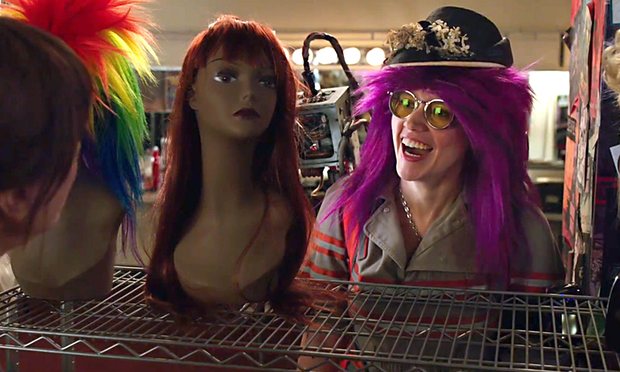
What’s interesting here, though, is that while McCarthy and Wiig anchor Ghostbusters admirably and do most of the heavy lifting in terms of plot development and emotional stakes, it is Kate McKinnon who delivers not only the lion’s share of the laughs but also the one true breakout performance of the film.

In a movie inspired by (kind of sort of) the Book of Revelation, McKinnon is a revelation unto herself.

Anyone who has watched Kate McKinnon on SNL over the past few years knows the raw comedic talent that she brings to the party. From her much-heralded take on Hillary Clinton to her smarmy imitation of Justin Bieber to her white trash alien abductee that forced character-breaking fits of laughter out of her fellow performers (hands-down the best sketch of SNL’s recent season), McKinnon has got the goods in spades.
kmwig

In Ghostbusters, McKinnon gets to spread her wings and experiment with a weird, probing performance that sets her apart from her costars in a way that really elevates the comedy. While McCarthy and Wiig get their laughs through more restrained performances and while Jones stays pretty much in the same box she has constructed for herself since coming onto the national scene, McKinnon gets to freestyle here, and the results are sublime. Like the background musician who suddenly overshadows the lead singer and brings the house down with an improvised guitar solo, McKinnon goes big and goes weird, making such interesting and unconventional choices with her character that you just can’t wait to see what she’s going to do next. More often than not, she gets it right and delivers.

Apart from McKinnon, one of the most notable things about this new Ghostbusters is its complete self-awareness and affection for its predecessor.

A parade of cameos throughout the film serve less as moments of comic inspiration than they do as endorsements from or tributes to the original Ghostbusters’ cast. Despite a flashy appearance by Bill Murray, the most affecting of these is a don’t-blink-or-you’ll-miss-it homage to Harold Ramis—co-writer and co-star of the original—who passed away in 2014 but appears here as a bronze bust outside Erin’s office at Columbia. Casual fans will recognize and appreciate the appearances by Murray, Dan Aykroyd, Sigourney Weaver, the Stay Puff Marshmallow Man, and others; but only the true fan will choke up over that brief glimpse of Ramis’ unmistakable figure standing guard in the hallway. His is the one ghost we hope our squadron of wonderful women warriors don’t blast back into the other dimension.

The Shallows

the-shallows-poster

The shark may well be the ultimate screen villain.

Deadly. Relentless. Without mercy. A killing machine with no pity, remorse, or shame. As someone said in the most famous shark movie of them all, “What we are dealing with here is a perfect engine, an eating machine. It’s really a miracle of evolution. All this machine does is swim and eat and make little sharks.”

And when it kills–whoa!—it kills in spectacular fashion.

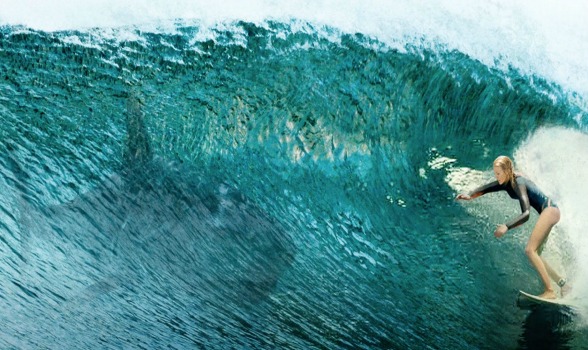
In time, The Shallows—the new thriller from Spanish director Jaume Collet-Serra—will be remembered, if at all, as just another shark movie. But in the moment, The Shallows is a taught, suspenseful survival tale that pits a game Blake Lively against Mother Nature’s perfect engine.

Lively’s grief-stricken surfer girl, Nancy, has lost her mother to cancer, left medical school, and retreated to a secluded Mexican beach to forget her troubles and ride the spectacular southern swells. Had she headed back to town after lunch, it truly would have been the perfect day. But, alas, she stays out a bit longer than she should, and before you can say “girl in peril”, she finds herself laying on an isolated rock two hundred yards from shore, blood gushing from a savage shark bite in her leg, and the rising tide threatening to wash her off of her safe place and into the jaws (no pun intended) of the great white shark lurking in the dark water. Facing near-impossible odds, the determined and resourceful Nancy rediscovers her lost will to live and sets about trying to find a way to get herself to safety before it’s too late.

Like many shark movies that take themselves seriously (no, I’m not talking to you, Sharknado), The Shallows must be judged against Spielberg’s 1975 masterpiece. That said, is it fair to say that The Shallows is better than one or more movies that has Jaws in its title followed by a number? Yes, absolutely. Does it even come close to the original Jaws? No way.

Then again, what does?

Jaws remains one of the most ground-breaking films of any genre in the history of film. Ranked number 48 on the American Film Institute’s roster of the 100 Greatest American Movies of All Time, Jaws is not only an outstanding film on the merits, but it also single-handedly created the idea of the summer blockbuster. For all the amazing things about Jaws, however—the phenomenal performances, the terrific writing, the rich characters—what is often lost about this timeless classic is just how good a horror film it really is. Jaws actually scares you. And it doesn’t just scare you in the moment: it lingers with you, it haunts you, and it plays with your mind whenever you dip your toe into the deep blue sea. It is not hype to say that an entire generation of moviegoers learned to be afraid of the water from Jaws.

The-Shallows-1-tiny

On its own terms, The Shallows provides its fair share of scares, as well, though its killer shark occasionally seems to be a bit too obsessed with  Nancy when, as the saying goes, there are plenty of other fish (and mammals, for that matter) in the sea. The great white of The Shallows seems to have been inspired by the masked killers of the 80’s slasher cycle in its single-minded drive to kill this one specific victim, but considering the tasty way in which the film presents Blake Lively, perhaps it’s hard to blame the precocious fish.

Especially in the film’s early scenes, director Collet-Serra leers at Lively. His gaze lingers on her every curve, from front to back, like a creepy neighbor in an upstairs window with a pair of binoculars.  He cuts from the magnificence of the secluded beach to the gorgeous tree line to Lively peeling off her clothes like she’s just another part of the scenery.

Lively, though, rises above it and proves to be much more than a pretty face. As the movie’s sole actor for probably 90% of its running time, Lively anchors the film effectively and does well to create a real character out of what essentially is a one-line scenario:  What would happen if a girl got caught alone on a rock in the middle of nowhere and had to match wills against a great white shark? There isn’t much room there for character development, but Lively does her level best.

In the end, though, The Shallows has little to do with character, plot, story, or any other element of traditional narrative. It’s about tension, suspense, and a massive, angry, lunging shark. In retrospect, that’s probably not enough. But in the dark of the theater, it makes for good, engaging summer entertainment.

Maggie’s Plan

mpposter1

Love is messy. An unoriginal observation, perhaps, but certainly right on the mark.

We fall in love. We fall out of love. We struggle to make it work. We mourn its passing. We take it for granted. We celebrate it. We covet it. And, at some point in our lives, we realize that love comes in all shapes, sizes, and varieties, though we don’t always get to choose the how’s or why’s or when’s or who’s. Leonard Cohen might have put it best when he sang, “To every heart, every heart, love will come…but like a refugee.”

Maggie’s Plan is all about love:  messy, complicated, grown-up love.

Greta Gerwig’s 30-something Maggie wants a baby. But she wants it on her own terms, on her own timetable, and to her own particular specifications. So Maggie sets off to engineer the little miracle, an effort that is complicated when she falls for married John (Ethan Hawke). Eventually, she decides that she wants John, too. On her own terms. On her own timetable. And to her own particular specifications. Before long, lucky Maggie has gotten exactly what she wanted—the baby, the man, and the life—but then starts to realize that she just might want something else, instead. On her own terms, on her own timetable…you get the idea.

The marketing folks behind Maggie’s Plan have packaged it as a “screwball comedy”, and it most decidedly is not that. Maggie’s machinations might be the stuff of screwball comedy, especially in the film’s second half, but the pace, performances, and tone of the film never actually rise to that screwball pitch. Instead, the film settles into a comfortable, leisurely gait, delivering some laughs, for sure, but at last becoming much more affecting than you ever expect going in.

Writer/director Rebecca Miller (The Private Lives of Pippa Lee, The Ballad of Jack and Rose) has a lot to say about adult love and relationships. The film starts out a bit uneven, the characters clichéd and two-dimensional, but as the film presses forward the characters begin to come into more clear focus and their motivations and reactions become more complex. It may be that writer-Miller was ultimately rescued by director-Miller, whose ability to masterfully conduct her orchestra of actors allows the film to find its way.

Of the three leads at the heart of Maggie’s Plan, Julianne Moore starts off on the shakiest ground. Playing John’s intellectual, ambitious wife, Georgette—broadly drawn as a caricature, outlandish accent and all—Moore quickly pivots away from her early over-the-top take on the character and by the end delivers a fully-realized, three-dimensional performance.

Ditto Ethan Hawke, who—truth be told—is never so effective as when he portrays slacking, emotionally-immature, self-centered dreamers. In that regard, John is tailor-made for the actor: a philandering would-be-novelist who romanticizes his love affair with a never-finished manuscript even as it seduces him into neglect and abandonment of his real-world relationships.

The irresistible force at the center of Maggie’s Plan, however, is the utterly indefatigable Greta Gerwig, into whose orbit the other characters dance and play and come and go like shooting stars. In the six years since her career kick-starter Greenberg, Gerwig has come to define indie-cred and indie-cool. From Lola Versus to Frances Ha to Mistress America and now Maggie’s Plan, Gerwig has cornered the market on the existential angst of going from young adult to actual grown up. In Maggie’s Plan, she is educated, has a good job at the New School in New York, but struggles to achieve a degree of personal happiness to go with her professional success. And she makes a hell of a lot of mistakes along the way.

Despite Gerwig’s natural charm and irresistible charisma, even admitted Gerwig obsessives (and believe me, I know of what I speak) will find Maggie a tad off-putting. She is not a bad person, per se, but her tendency towards manipulation, duplicity, and self-deception—while making her very real, certainly—suggests caution before letting her get too close to your heart. Indeed, only during a handful of disarming moments with her young daughter Lilly does Maggie let her guard down and allow herself instants of genuine joy and love, but those are few and far in between.

Not that John or Georgette are such saints, either. It would seem that the central requirement for occupying a corner of Maggie’s love triangle is total self-centeredness and a lack of self-awareness. In fact, that combination may well have been the recipe for the “screwball comedy” that the marketers imagined.

Instead, though, after a few early bumps in the road and despite a bit of plot silliness here and there, Maggie’s Plan turns out to be an honest, engaging snapshot of yearning, aspiration, heartache, and—though the arrow never quite lands where it is aimed—that lonely refugee love.

The Witch

thewitch

The terror flares suddenly: shocking, disturbing moments and images that combust, scald, and then leave you in lingering psychological distress. Until the next flash, moral dread smolders sinisterly and mockingly, waiting for the next opportunity to shock you once again.

Such is the horror of The Witch.

A breakout hit at Sundance last year, The Witch earned first-time director Robert Eggers the top prize in directing, and in the intervening year distributers have used that indie cred, terrific word of mouth, and aggressive social media marketing to build Blair Witch Project levels of anticipation. And the film ends up to be well worth the wait.

A skin-crawling exercise in Christian paranoia and psychological horror, The Witch begins with the ouster of a devout Puritan family—for reasons not entirely clear—from their Salem-era New England plantation town. The family settles in the wilderness on the edge of a foreboding forest, builds a home, and sets about trying to establish a farm and a new life. When their infant son, Samuel, disappears suddenly while in the care of teenage daughter Thomasin, the family dynamics unravels rapidly, leading to suspicion, resentment, and an overwhelming sense of inexorable dread. At no point is there any doubt that this family is doomed, and as the story unfolds, the only question becomes whether it will be internal or external forces that ultimately destroy them.

One of the triumphs of The Witch is its ability to take the mundane or the innocuous and infuse it with disturbing portent. A rabbit in the forest staring down a hunter fumbling with his rifle. Fraternal twins Mercy and Jonas romping in the yard with the family goat, Black Phillip. An innocent game of peek-a-boo that ends catastrophically. The deceptions, impotency, and sin that overwhelm this family infect every aspect of their lives, coloring their perceptions, driving their reactions, and pushing them along their hopeless path.

At the epicenter of The Witch stands Thomasin—played by newcomer Anya Taylor-Joy, in her first credited screen role—whose transformation from girl to woman is fueling the dark forces that tear the family apart. Taylor-Joy delivers a pitch-perfect performance full of innocence, fear, confusion, discovery, anger, trepidation, and wonder. As Thomasin, she dances amongst the contradictions, alternatively withdrawing into herself and then exploding in defiance of the sinister influences all around her.

Modern horror fans will split over The Witch. More Rosemary’s Baby than recent horror hits like The Purge, Insidious, or Paranormal Activity, the slow-burn of The Witch offers precious few moments of sneak-up-behind-you shock, sudden violence, or gore. And when those types of moments do come, they come and go in an instant, imprinting on the viewer’s psyche and then receding into the ether, leaving you to wonder what it was you actually saw or what it meant.

The Witch isn’t particularly interested in explanations or clarifications. It simply casts its spell; conjures its brew of unease, anxiety, and dread; and then casts you out of the darkness of the theater and into the darkness of your own mind to let you decide what it all meant.

You may not like the answer.

Alan Rickman: Yippee-ki-yay, Motherf#cker.

alan-rickman-diehard-11

We will always be grateful for Hans Gruber.

When Die Hard hit theaters in 1988, it felt like something we had never seen before: a different kind of action movie that would reset the genre for a generation or more. The action was riveting. The humor was sharp. It gave us a new kind of hero. And the whole thing felt glossy and polished.

And then there was Alan Rickman.

Of all the things about Die Hard that we had never seen before, Alan Rickman rises to the top of the list. Making his film debut as villain Hans Gruber, Rickman immediately and indelibly emerged as a cinematic force to be reckoned with. To borrow a phrase from another hit movie that came out the very same year, Rickman announced his presence with authority.

As the poisonous Hans Gruber, Alan Rickman was a revelation, taking a two-dimensional archetype and breathing into it three-dimensional, glorious life. Part low-rent Bond villain, part frustrated junior college professor, Rickman’s Gruber slithered across Die Hard boldly and confidently, leaving a trail of irresistible slime in his wake. We laughed at his snarling invectives. We gasped as his acts of cold blooded murder. We reveled with him in his moment of triumph. And we marveled in utter fascination at his every move across the screen. It was impossible to look away from him.

In a movie built to showcase Bruce Willis as Action Hero 2.0 (long before anyone would have known what “2.0” meant), unknown Alan Rickman went toe-to-toe with the emerging movie star and in large part stole the show. With wit and rage and subtlety and smarm, Rickman gravitated toward the center of the film and never relinquished the spotlight.

It is no coincidence that the Die Hard sequels paled in comparison to the original. None featured Rickman’s devilish presence, and none could match the fun of the first.

Of course, Alan Rickman would himself go on to have a Hall of Fame career.

His Sheriff of Nottingham was extraordinary and by far the best thing about the otherwise-unbearable Robin Hood: Prince of Thieves. He delivered brilliant comic turns in the incisive Bob Roberts and the broader Galaxy Quest. His imprudent flirtation with a secretary in the wonderful Love Actually gives dramatic weight to an otherwise light and airy romantic comedy. For one generation, he will always be known for his tender performances in films like Truly, Madly, Deeply and Sense and Sensibility; and for another, they may never see him as anyone other than Harry Potter‘s Severus Snape.

And for those of us who first saw him snarling at us from the big screen in his motion picture debut, he will always be Hans Gruber.

Alan Rickman’s death this week left cinephiles across the globe in mourning. He was a towering figure in the film world who will be sorely missed, and there will simply never be another like him.

Some will bid him Godspeed.

Others will wish him Rest in Peace.

And for the rest of us, only one final farewell seems appropriate.

Yippee-ki-yay, motherfucker.

Top 10 Films of 2015

With 2015 now officially in the rear view mirror, it turns out to have been a sneaky-good year at the movies. Despite The Force Awakens pretty much sucking all of the oxygen out of the cinema universe this year—even before its mega-debut in December—2015 gave us some quality films throughout the year.

The following Top 10 represents, in no particular order (well, in alphabetical order, in fact), my own personal “best of” list for 2015. Many of these will be found on other critics’ best of lists, and many of them will be awards contenders in the coming months. Some, however, simply struck a nerve with this particular critic and found their way onto the list. If you think there is movie missing that should be on the list, it’s entirely possible that I didn’t get to see it this year…or that it simply didn’t make my cut. That shouldn’t stop you from putting it on your own list, however!

The Big Short

big short

Corruption. Stupidity. Greed. Co-writer and director Adam McKay posits in The Big Short that it was the confluence of those particular sins that led to the global financial disaster in the first decade of this century; and he presents the lead-up to that meltdown through the stories of three teams of financial professionals who saw it coming and set out to profit from it. For a story that unfolds primarily through phone calls, in Wall Street meeting rooms, and around the analysis of mortgage documents and investment prospectuses, The Big Short bristles with creativity and energy. Not to mention moral outrage. Steve Carell, Ryan Gosling, Christian Bale, and Brad Pitt headline the cast—with Carell and Bale delivering the most interesting takes on their real-life characters—but this is a movie that succeeds because of the collective. Lead actors and the supporting cast alike rivet from start to finish. There is nothing on Adam McKay’s robust comedy resume (the Anchor Man movies, Talladega Nights, Step Brothers, and more) to suggest that he could deliver a film of such incisive wit and moral weight, but with The Big Short he may have written and directed the best film of the year.

Ex Machina

Ex-Machina-Cast

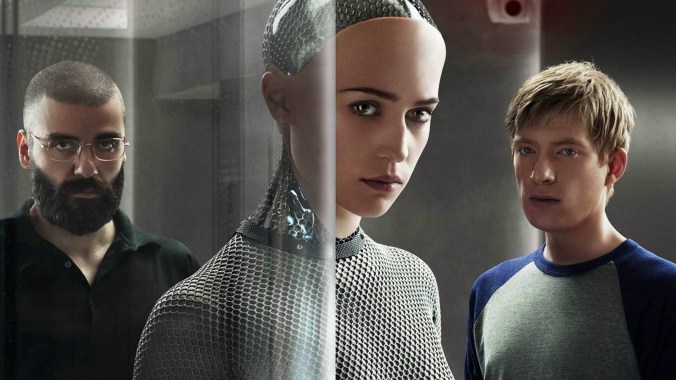
It’s no coincidence that Oscar Isaac appears in three of the films on this particular “best of” list. In 2015, he confidently staked his claim as one of the finest actors of his generation. In Ex Machina, he portrays a reclusive tech genius who just may have produced the world’s first sentient machine. He invites a star employee of his tech empire to his secluded island estate and introduces him to Ava (or is it Eve?), his latest version of sexualized artificial intelligence. Alicia Vikander slyly portrays Eva as Woman.0, and by the end of the movie we hear her roar. Ex Machina is a creepy, slow burn, and it lingers long after the final credits roll.

It Follows

itfollows

The most interesting and understated horror movie of the year was It Follows. Part supernatural horror and part surprisingly complex morality tale, It Follows both subverts and validates the genre’s conventions regarding sex, death, and punishment. After a young girl is seduced into a sexual encounter with a mysterious new boyfriend, she finds herself haunted and pursued by an evil demon that inexorably stalks her no matter where she tries to run or hide. She can’t destroy it, and she can’t escape it. Her only hope of surviving is to have sex with another person, which will then pass the curse from her to her partner. What could have been a clumsy, typical teen blood fest is instead, in the hands of writer/director David Robert Mitchell, a masterclass in mounting suspense and hair-raising imagery. Though it rattles off the rails a bit in its closing stages, the difficulties with its resolution are not enough to undermine the style and power woven into the rest of the film.

Love & Mercy

cusack

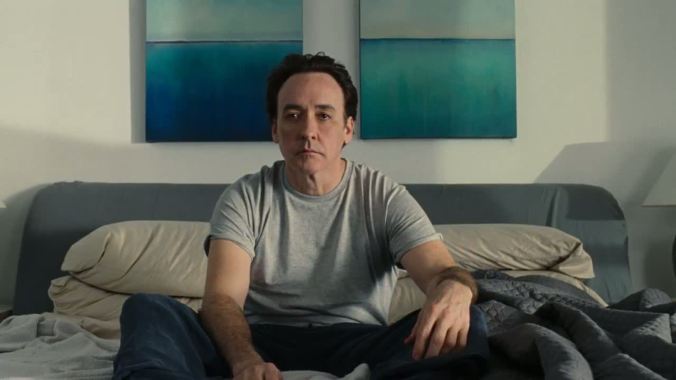
Love & Mercy alternates back and forth between the two periods in life of Brian Wilson, the creative genius behind The Beach Boys. Paul Dano portrays a younger, faltering Wilson, and John Cusack fills the role of an older, emotionally broken Wilson. The unconventional approach—two different adult actors playing the same character at different points of his life—works in unexpected and riveting ways. After two decades of struggle with debilitating mental illness, drug abuse, and family turmoil, the fragile, dependent Wilson of the 1980’s indeed seems to have been a completely different man than the energetic, dynamic Wilson of the Pet Sounds era. Dano and Cusack famously did not coordinate their takes on Wilson and barely even met before or during the film’s production, and as a result their individual portrayals of the man are crafted and shaded in their own unique ways. And both deliver, as does a stellar Elizabeth Banks in a supporting role. Read Madison Film Guy’s full review here.

Mistress America

mistress

Indie actress-cum-screenwriter Greta Gerwig has emerged in recent years as a truly idiosyncratic cinematic voice, with her latest film, Mistress America, a minor-though-charming addition to her growing and impressive filmography. Mistress America, which Gerwig stars in, co-produced, and co-wrote with director and best beau Noah Baumbach, is an unexpansive meditation on loneliness, narcissism, and the cult of (failed) ambition. And, like much of Gerwig’s most personal work to date, it delights in the struggle of a generation desperate to find its place as it comes to terms with the twilight of youth and the dawn of adulthood. Gerwig’s cinematic baptism has come at the altar of filmmakers like Whit Stillman and Baumbach himself, and it shows in her scripting of Mistress America. And that’s not a bad thing. Though less self-conscious—but dramatically warmer—than movies like Metropolitan or Damsels in Distress (which Gerwig starred in, as well), Gerwig the writer shares a talky, erudite style with Stillman and Baumbach. But her earthy, human moments are significantly more impactful and resonant. Read Madison Film Guy’s full review here.

A Most Violent Year

amostviolentyear1

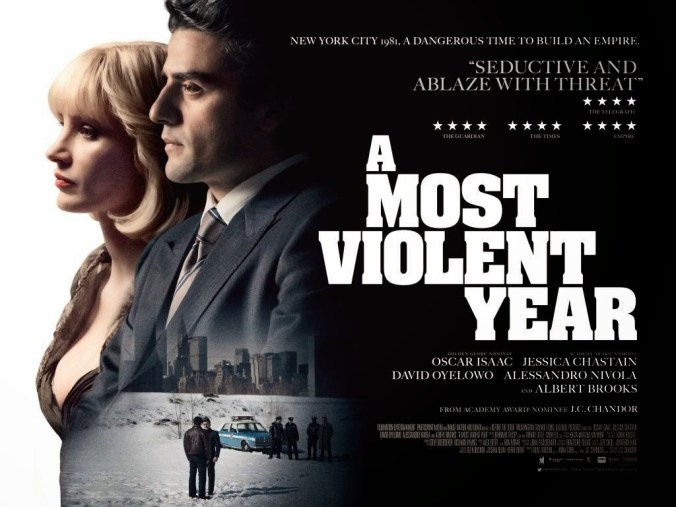
Sidney Lumet was a titan of 1970’s filmmaking, imbuing his films with rich complexity and indelible style. Though his career spanned more than 50 years, in that one decade alone, Lumet gave us such signature films as Serpico, Dog Day Afternoon, and Network, among many others. Lumet died in 2011, but director J.C. Chandor seems to have been channeling the great man’s spirit in A Most Violent Year. Technically released (limited) on December 31 of 2014, I’m going to count A Most Violent Year on this list, because it didn’t really hit theaters until the early part of 2015. And it would be a shame not to give it its due. With the look and feel of a 1970’s gangster film but the pacing of a deeply personal drama, the film tells the story of an ambitious Latino immigrant attempting to protect his business, his family, and his honor during the violence of 1981 New York City. Starring Oscar Isaac and Jessica Chastain, A Most Violent Year never combusts, but it smolders with quiet, restrained intensity in every frame.

Spotlight

spotlight

An example of your classic late-year prestige picture, Spotlight checks off all the right boxes to make it a serious Oscar contender: great ensemble cast, important subject, quality script and direction, and pretty much everyone involved putting their best foot forward. Directed by Tom McCarthy, Spotlight chronicles the months-long quest by the Boston Globe’s “Spotlight” investigative team to draw back the curtain on Boston’s massive clergy-abuse scandal in the early 2000’s. The film functions not only as a scathing indictment of the role of the Catholic church in covering up and perpetuating the abuse, but also as a testament to the importance of a strong, healthy free press in exposing and challenging the wrongdoing of the most powerful institutions in  society.

Star Wars: The Force Awakens

force

The story and thematic parallels between this film and the original Star Wars have been much remarked upon in recent weeks and in some quarters roundly criticized, but for the most part, The Force Awakens actually delivers on the year-long hype and decades-long anticipation that ushered in its arrival. “It’s true,” Harrison Ford’s Han Solo assures us at one point. “All of it. The Dark Side, the Jedi. They’re real.” That’s how we felt watching Star Wars for the first time nearly 40 years ago, and that’s how this movie makes us feel once again. The Force Awakens is the movie we’ve been waiting for since 1983, and you come away from it reassured of one thing: The Force will be with you. Always. Read Madison Film Guy’s full review here.

Steve Jobs

jobs

Deconstructing Apple co-founder Steve Jobs through an interesting, practically theatrical 3-act structure, writer Aaron Sorkin and director Danny Boyle paint a portrait of a self-righteous, morally fallible genius who is wrong more than he is right. But when he’s right–whoa!–he’s really right. Sorkin’s crackling script, Kate Winslet’s Oscar-worthy second banana, and a host of solid supporting turns (Seth Rogan and Jeff Daniels, among them) take a backseat to Michael Fassbender’s intense, penetrating portrayal of Jobs himself. Fassbender has been putting some riveting work on film the last several years, and here he is alternatively seductive and repugnant. In berating loyal employee Andy Hertzfeld before the launch of the Apple Macintosh computer, Fassbender’s Jobs hisses, “You had three weeks. The universe was created in a third of that time.” Without skipping a beat, Hertzfeld replies, “Well, someday you’ll have to tell us how you did it.” And that’s Steve Jobs in a nutshell.

What We Do in the Shadows

shadows-quad

Released in the United States in early 2015, What We Do in the Shadows succeeds due in large part to its palpable love and appreciation of the horror classics. Its humor may be modern, but its roots and inspiration burrow through more than a century of classic horror cinema. More Young Frankenstein than Scary Movie 5, Shadows’ affectionate take on the horror comedy offers equal parts satire and homage, with dashes of genuine melancholy and dread thrown in for good measure. It’s an instant classic. Read Madison Film Guy’s full review here.

Star Wars: The Force Awakens

star-wars-force-awakens-official-poster

A long time ago in a galaxy far, far away…

In more than a century of motion picture history, one would be hard pressed to come up with a more eagerly anticipated, massively-hyped film than Star Wars: The Force Awakens. Sure, in recent years, there have been huge franchises that have largely lived up to their billing (Lord of the Rings and Harry Potter and even The Hunger Games are just a few examples). There have been massive best-seller books made into wildly over-hyped movies (Fifty Shades of Grey, anyone?). And there have even been unexpected visits from old friends that we thought we may never hear from again…and ultimately probably shouldn’t have (Indiana Jones and the Kingdom of the Crystal Skull, ugh).

But in today’s age of brute force marketing, corporate cross-promotion, and social media madness, the art of anticipation has reached its golden age.

Thus we have the phenomenon of Star Wars: The Force Awakens, and for some of us, it has been pure heaven.

And when I say “some of us”, let me be precise as to who I’m talking about:

I’m talking about people of a certain age, let’s just say mid-40’s to be kind about it. Men in their mid-40’s, in fact, though certainly there are plenty of women who are equally fanatical. I’m talking about those people who stood in line—in long lines, blocks long—when the original Star Wars came out in 1977 and played at the single-screen movie theater in downtown wherever. Those whose annual St. Nick’s Day stockings and Easter baskets were filled with Star Wars figures. Those who grew up reading books with titles like Han Solo and the Lost Legacy and Lando Calrissian and the Mindharp of Sharu. Those who watched The Star Wars Holiday Special in 1978…and then waited breathlessly—though fruitlessly—for it to air again in the coming years. Those who bragged in our youth that we could recite Star Wars line for line from memory—and could!—and never figured out why we were in our late teens before we had our first date.

Don’t get me wrong: Star Wars fandom absolutely crosses generational, gender, cultural, and just about every other line you can imagine, but there is something special about having been on the ground floor of this particular cultural phenomenon and now seeing new, glorious life breathed into the cherished franchise once again.

The Force Awakens succeeds where the prequels failed (miserably failed, to be sure, though even I will admit that there were some engaging moments here and there) by paying proper deference to and recapturing the spirit of the original trilogy. The new movie just feels like Star Wars, and the return of so many familiar faces and long-lost friends creates the atmosphere of a welcome family reunion.

It takes a while for the reunion to unfold, however.

The Force Awakens takes its time introducing the next generation, as it were (sorry, Trekkies). New heroes, new villains, and even a new adorable robot sidekick dominate the early stages of the film, and it’s all fun and enjoyable to look at, with a capable and engaging young cast that you begin to feel you may just be able to trust with the franchise.

But when Han Solo and Chewbacca burst into the frame for the first time, the movie kicks into proverbial hyperdrive and begins to gather its emotional steam. “Chewie, we’re home,” Han Solo effuses as he re-boards the Millennium Falcon for the first time in ages, and at that moment, every single person in the audience feels exactly the same. We’re home. And that’s when—for some—eyes start to grow misty and perhaps even a single tear rolls down a cheek. And suddenly The Force Awakens begins to soar.

One by one, old friends join the party—human, alien, and machine alike—and one by one it feels as if they had never gone away. Even lines of dialogue—“May the force be with you”—feel like a warm hug from a lost love.

The plot is the plot, which is to say that if you’ve seen Star Wars (I refuse to subtitle it A New Hope, because that’s revisionist), you’ve pretty much seen The Force Awakens. That doesn’t mean that it’s a remake, per se; but the new film tracks much the same as the original did: plot points, character archetypes, and even twists, to some degree. The story and thematic parallels between this film and the original have been much remarked upon in recent weeks and in some quarters roundly criticized, but it is that familiar structure that allows us to remain comfortable and patient as the early introductions play out and we wait for the reunion to come.

Of the veteran cast, Harrison Ford does most of the heavy-lifting as Han Solo, who has matured from scoundrel to curmudgeon in the 30-ish years between Return of the Jedi and this latest installment. And that’s just fine, because even though the original Star Wars trilogy was Luke Skywalker’s story, Han Solo has always been the most fun and intriguing character. It also helps that of all the original cast, Academy Award nominee Ford also has displayed the most serious acting chops of the bunch. So, putting him front and center of The Force Awakens feels like the right thing to do.

Of the newbies, the talented group of John Boyega, Adam Driver, and Oscar Isaac perform admirably enough in roles of varying significance; but it is newcomer Daisy Ridley, as the desert scavenger-cum-quasi-Jedi, who shines most brilliantly. Ridley’s Rey is a revelation of charisma, intensity, authenticity, and flat-out girl power; and if this trilogy in fact turns out to be Rey’s story—as this film strongly suggests—then we have a lot to look forward to in the coming years.

For both the uninitiated (if there truly are any at this point) and the casual fan, The Force Awakens bristles with enough adventure, action, and pure kinetic energy to gloss over the occasional lapses in plot or some of the undeveloped logic of this particular past/future galaxy.

However, for the rest of us, The Force Awakens is far more than an entertaining new film.

It is an emotionally rewarding extension of the mythology of our childhood. It is the welcome erasure of not only Jar Jar Binks, but also of the unnerving racism and cult of petulance that defined the prequel trilogy. It is a movie that makes us feel again like the wide-eyed kids we once were when we sat in a theater and saw for the first time something that we had never even dared to imagine before.

“It’s true,” Han Solo assures us. “All of it. The Dark Side, the Jedi. They’re real.”

That’s how we felt watching Star Wars for the first time nearly 40 years ago, and that’s how this movie makes us feel once again.

The Force Awakens is the movie we’ve been waiting for since 1983, and you come away from it reassured of one thing:

The Force will be with you. Always.

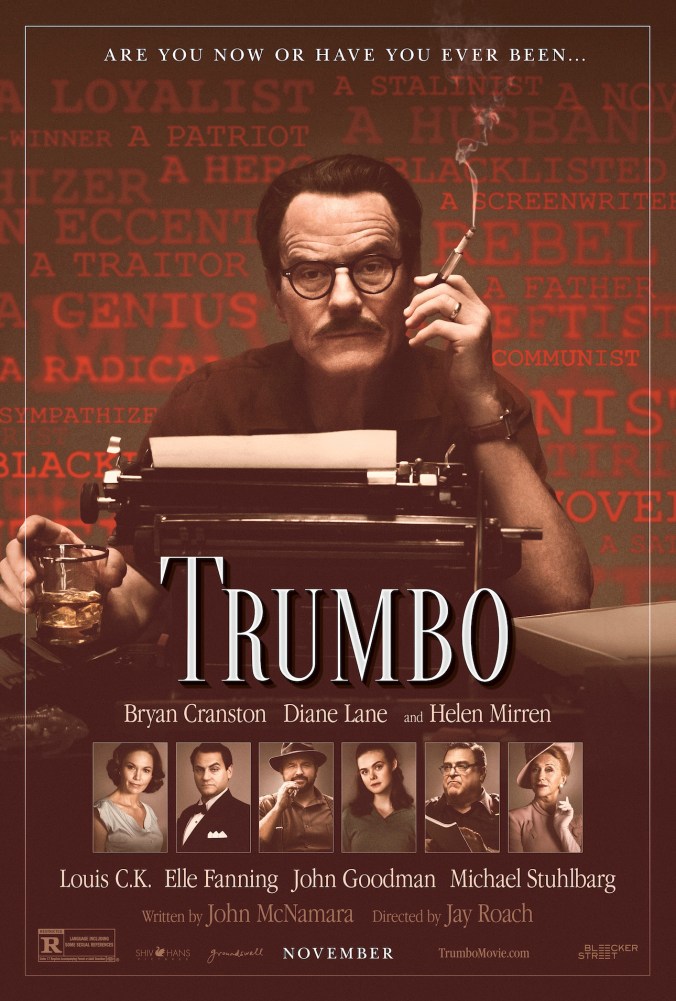
Trumbo

trumboposterThere have been a number of movies in the last year that have been, despite their excellence, particularly hard to watch. Selma comes to mind, as it was difficult not to juxtapose yesterday’s historic struggle for voting rights for African Americans with today’s dispiriting attempts to roll those same rights back and disenfranchise those same people. Suffragette elicited a similar reaction, presenting a striking dramatization of the struggle of women to achieve social justice and independence, released during this year in which women’s rights are under cynical and flagrant attack once again.
The new film, Trumbo, presents a similar intellectual anxiety.

The true story of an Oscar-winning screenwriter blacklisted during the ugly McCarthy era in America, Trumbo stars Bryan Cranston in the title role of Dalton Trumbo, and he delivers a pitch-perfect performance full of wit and rage and fear and indignation.

Trumbo unfolds in an American era in which the country was deeply divided by fear and mistrust, much of it stemming from a mysterious foreign menace that seemed to threaten our way of life…and cynically fueled by opportunistic, craven politicians who saw in that threat the prospect of self-promotion. They questioned the loyalties of people based on the number of vowels or the arrangement of consonants in their last names. Americans whose politics differed from theirs were labeled as traitors. And people were persecuted, victimized, and stripped of their rights despite having perpetrated no wrongdoing nor having committed no crime.

All that resonates as uncomfortably familiar even to those of us who were born long after most of the events of Trumbo take place.

Dalton Trumbo was a communist—which is to say that he was member of the American political party called the Communist Party—and was active and vocal in supporting workers’ rights, unionism, and the First Amendment to the Constitution of the United States. He also was a self-admitted “rich guy”, whose Hollywood success had provided him and his family with plenty to lose when Trumbo decided to stand up the infamous House Un-American Activities Committee. Convicted of contempt of Congress, Trumbo served nearly a year in a federal prison in Kentucky, and when he was released, he was blacklisted from working as a writer.

But Trumbo fought back.

Hollywood has tackled the blacklists before, of course. Robert DeNiro headlined 1991’s Guilty by Suspicion, and George Clooney delivered the consummate prestige picture in 2005, directing Good Night, and Good Luck. Even before those, in 1976, Woody Allen starred in The Front, a simple but effective comedy-drama that had the distinction of being written by (Walter Bernstein), directed by (Martin Ritt), and starring (Zero Mostel, Herschel Bernardi, and Lloyd Gough) a number of artists who themselves had actually been blacklisted.

Trumbo takes a bit from each of those films, combining the personal drama of Guilty by Suspicion with the moral outrage of Good Night, and Good Luck and the dry wit of The Front. The result is a more three-dimensional film that works on multiple levels

The primary joy of Trumbo, though, is watching Bryan Cranston bring to life this strange, unlikely hero. Lurching from moments of thundering indignation to fragile vulnerability and back, Cranston creates a character who is full of contradictions in some ways, but one whose single-minded focus on justice—which just so happens to also mean redemption and security for him and his family—drives him from the opening frames to the closing credits.

The challenge of Trumbo, though, is to embrace and understand that it is neither fiction nor ancient history, and that underneath the drama and entertainment is a moral lesson that can help us understand and interpret the world around us today.

Trumbo would have wanted it that way.

31 Films of Halloween – 10/25/15: Extraordinary Tales

Throughout October, Madison Film Guy will post new mini-reviews/recommendations/musings on contemporary or classic horror films to help celebrate my 31 favorite days of the year: the countdown to Halloween! Today’s film: Extraordinary Tales.

extraordinary

Extraordinary Tales, 2015

Speaking of extraordinary, it has been an extraordinarily tricky proposition to  bring Edgar Allan Poe’s tales to the big screen.

Though many films—and many of them truly great—purport to be based on, inspired by, or loosely adapted from Poe’s masterworks, precious few have been able to actually convey the classic stories or poems as they were intended by the author.

The animated anthology Extraordinary Tales is the exception, and it is a scrumptious appetizer to this year’s delicious Halloween feast, faithfully adapting some of the best entries in Poe’s canon of “love letters to death.”

Loosely organized around a (largely perfunctory, unfortunately) conversation between the spirit of Poe—a raven—and Death herself, Extraordinary Tales spins five beautifully animated tales of madness and terror mostly narrated and/or voiced by masters of horror.

Sir Christopher Lee lends (in an original recording, one of his final performances) his authoritative baritone to the film’s take on The Fall of the House of Usher. Bela Lugosi gets inside the head of the unbalanced murderer of The Tell-Tale Heart. Julian Sands hisses his way through the grim procedural The Facts in the Case of M. Valdemar. Modern master Guillermo del Toro lends his grim tone to the torturous tale of the Spanish Inquisition, The Pit and the Pendulum. And Roger Corman—perhaps in a nod to his own rich catalogue of loose Poe adaptations—voices the decadent Prince Prospero in The Masque of the Red Death.

If Poe’s tales are, as the film notes, “love letters to death”, then Extraordinary Tales must be a love letter to Poe himself. Written and directed by Raul Garcia, who has worked on the animation teams for some of the biggest animated films in recent years, Extraordinary Tales brings each of Poe’s stories to life in a different style and tone. Each singularly captivating. Each gorgeous in its own way. Each expressing an inner or outer horror in ways that live-action filmmaking can rarely capture.

Though all are wonderful, there is particular joy to be found in Garcia’s take on The Tell-Tale Heart. Despite a poorly-recorded voice track (all scratches and hisses and ambient hum) that is thought to be nearly 70 years old, Lugosi’s interpretation of the narrator’s madness—from self-congratulatory calm to desperate paranoid confession—is absolutely intoxicating. At the same time, the gothic animation of the tale is bold and striking.

A close second (though why rank at all?) would be the film’s version of The Fall of the House of Usher, which perfectly captures Poe’s expression of the inexorable decay of the noble bloodline of Usher through the crumbling foundation, the collapsing walls, and the shattering windows of their ancient home.

There may be a more perfect cinematic adaptation of Poe’s greatest works…nevermore.