Top 10 Films of 2015

With 2015 now officially in the rear view mirror, it turns out to have been a sneaky-good year at the movies. Despite The Force Awakens pretty much sucking all of the oxygen out of the cinema universe this year—even before its mega-debut in December—2015 gave us some quality films throughout the year.

The following Top 10 represents, in no particular order (well, in alphabetical order, in fact), my own personal “best of” list for 2015. Many of these will be found on other critics’ best of lists, and many of them will be awards contenders in the coming months. Some, however, simply struck a nerve with this particular critic and found their way onto the list. If you think there is movie missing that should be on the list, it’s entirely possible that I didn’t get to see it this year…or that it simply didn’t make my cut. That shouldn’t stop you from putting it on your own list, however!

The Big Short

big short

Corruption. Stupidity. Greed. Co-writer and director Adam McKay posits in The Big Short that it was the confluence of those particular sins that led to the global financial disaster in the first decade of this century; and he presents the lead-up to that meltdown through the stories of three teams of financial professionals who saw it coming and set out to profit from it. For a story that unfolds primarily through phone calls, in Wall Street meeting rooms, and around the analysis of mortgage documents and investment prospectuses, The Big Short bristles with creativity and energy. Not to mention moral outrage. Steve Carell, Ryan Gosling, Christian Bale, and Brad Pitt headline the cast—with Carell and Bale delivering the most interesting takes on their real-life characters—but this is a movie that succeeds because of the collective. Lead actors and the supporting cast alike rivet from start to finish. There is nothing on Adam McKay’s robust comedy resume (the Anchor Man movies, Talladega Nights, Step Brothers, and more) to suggest that he could deliver a film of such incisive wit and moral weight, but with The Big Short he may have written and directed the best film of the year.

Ex Machina
Ex-Machina-Cast

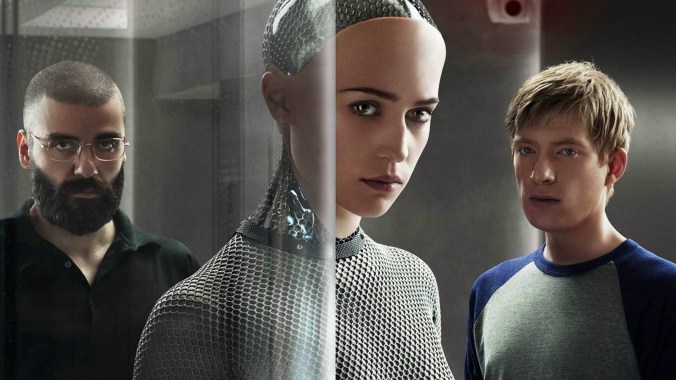
It’s no coincidence that Oscar Isaac appears in three of the films on this particular “best of” list. In 2015, he confidently staked his claim as one of the finest actors of his generation. In Ex Machina, he portrays a reclusive tech genius who just may have produced the world’s first sentient machine. He invites a star employee of his tech empire to his secluded island estate and introduces him to Ava (or is it Eve?), his latest version of sexualized artificial intelligence. Alicia Vikander slyly portrays Eva as Woman.0, and by the end of the movie we hear her roar. Ex Machina is a creepy, slow burn, and it lingers long after the final credits roll.

It Follows
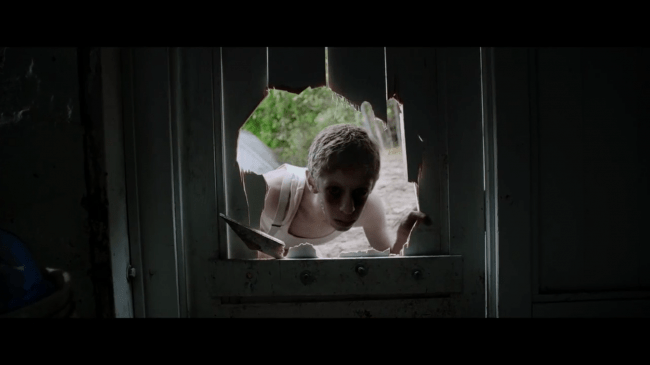
itfollows

The most interesting and understated horror movie of the year was It Follows. Part supernatural horror and part surprisingly complex morality tale, It Follows both subverts and validates the genre’s conventions regarding sex, death, and punishment. After a young girl is seduced into a sexual encounter with a mysterious new boyfriend, she finds herself haunted and pursued by an evil demon that inexorably stalks her no matter where she tries to run or hide. She can’t destroy it, and she can’t escape it. Her only hope of surviving is to have sex with another person, which will then pass the curse from her to her partner. What could have been a clumsy, typical teen blood fest is instead, in the hands of writer/director David Robert Mitchell, a masterclass in mounting suspense and hair-raising imagery. Though it rattles off the rails a bit in its closing stages, the difficulties with its resolution are not enough to undermine the style and power woven into the rest of the film.

Love & Mercy
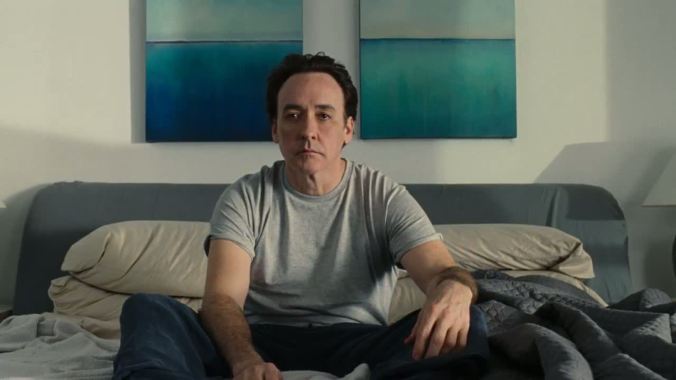
cusack

Love & Mercy alternates back and forth between the two periods in life of Brian Wilson, the creative genius behind The Beach Boys. Paul Dano portrays a younger, faltering Wilson, and John Cusack fills the role of an older, emotionally broken Wilson. The unconventional approach—two different adult actors playing the same character at different points of his life—works in unexpected and riveting ways. After two decades of struggle with debilitating mental illness, drug abuse, and family turmoil, the fragile, dependent Wilson of the 1980’s indeed seems to have been a completely different man than the energetic, dynamic Wilson of the Pet Sounds era. Dano and Cusack famously did not coordinate their takes on Wilson and barely even met before or during the film’s production, and as a result their individual portrayals of the man are crafted and shaded in their own unique ways. And both deliver, as does a stellar Elizabeth Banks in a supporting role. Read Madison Film Guy’s full review here.

Mistress America

mistress

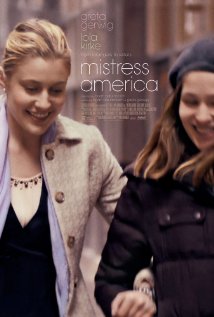
Indie actress-cum-screenwriter Greta Gerwig has emerged in recent years as a truly idiosyncratic cinematic voice, with her latest film, Mistress America, a minor-though-charming addition to her growing and impressive filmography. Mistress America, which Gerwig stars in, co-produced, and co-wrote with director and best beau Noah Baumbach, is an unexpansive meditation on loneliness, narcissism, and the cult of (failed) ambition. And, like much of Gerwig’s most personal work to date, it delights in the struggle of a generation desperate to find its place as it comes to terms with the twilight of youth and the dawn of adulthood. Gerwig’s cinematic baptism has come at the altar of filmmakers like Whit Stillman and Baumbach himself, and it shows in her scripting of Mistress America. And that’s not a bad thing. Though less self-conscious—but dramatically warmer—than movies like Metropolitan or Damsels in Distress (which Gerwig starred in, as well), Gerwig the writer shares a talky, erudite style with Stillman and Baumbach. But her earthy, human moments are significantly more impactful and resonant. Read Madison Film Guy’s full review here.

A Most Violent Year
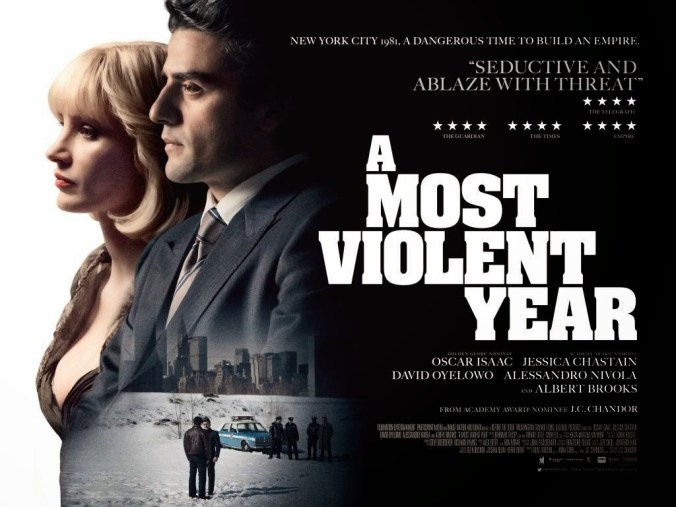
amostviolentyear1

Sidney Lumet was a titan of 1970’s filmmaking, imbuing his films with rich complexity and indelible style. Though his career spanned more than 50 years, in that one decade alone, Lumet gave us such signature films as Serpico, Dog Day Afternoon, and Network, among many others. Lumet died in 2011, but director J.C. Chandor seems to have been channeling the great man’s spirit in A Most Violent Year. Technically released (limited) on December 31 of 2014, I’m going to count A Most Violent Year on this list, because it didn’t really hit theaters until the early part of 2015. And it would be a shame not to give it its due. With the look and feel of a 1970’s gangster film but the pacing of a deeply personal drama, the film tells the story of an ambitious Latino immigrant attempting to protect his business, his family, and his honor during the violence of 1981 New York City. Starring Oscar Isaac and Jessica Chastain, A Most Violent Year never combusts, but it smolders with quiet, restrained intensity in every frame.

Spotlight

spotlight

An example of your classic late-year prestige picture, Spotlight checks off all the right boxes to make it a serious Oscar contender: great ensemble cast, important subject, quality script and direction, and pretty much everyone involved putting their best foot forward. Directed by Tom McCarthy, Spotlight chronicles the months-long quest by the Boston Globe’s “Spotlight” investigative team to draw back the curtain on Boston’s massive clergy-abuse scandal in the early 2000’s. The film functions not only as a scathing indictment of the role of the Catholic church in covering up and perpetuating the abuse, but also as a testament to the importance of a strong, healthy free press in exposing and challenging the wrongdoing of the most powerful institutions in  society.

Star Wars: The Force Awakens

force

The story and thematic parallels between this film and the original Star Wars have been much remarked upon in recent weeks and in some quarters roundly criticized, but for the most part, The Force Awakens actually delivers on the year-long hype and decades-long anticipation that ushered in its arrival. “It’s true,” Harrison Ford’s Han Solo assures us at one point. “All of it. The Dark Side, the Jedi. They’re real.” That’s how we felt watching Star Wars for the first time nearly 40 years ago, and that’s how this movie makes us feel once again. The Force Awakens is the movie we’ve been waiting for since 1983, and you come away from it reassured of one thing: The Force will be with you. Always. Read Madison Film Guy’s full review here.

Steve Jobs

jobs

Deconstructing Apple co-founder Steve Jobs through an interesting, practically theatrical 3-act structure, writer Aaron Sorkin and director Danny Boyle paint a portrait of a self-righteous, morally fallible genius who is wrong more than he is right. But when he’s right–whoa!–he’s really right. Sorkin’s crackling script, Kate Winslet’s Oscar-worthy second banana, and a host of solid supporting turns (Seth Rogan and Jeff Daniels, among them) take a backseat to Michael Fassbender’s intense, penetrating portrayal of Jobs himself. Fassbender has been putting some riveting work on film the last several years, and here he is alternatively seductive and repugnant. In berating loyal employee Andy Hertzfeld before the launch of the Apple Macintosh computer, Fassbender’s Jobs hisses, “You had three weeks. The universe was created in a third of that time.” Without skipping a beat, Hertzfeld replies, “Well, someday you’ll have to tell us how you did it.” And that’s Steve Jobs in a nutshell.

What We Do in the Shadows

shadows-quad

Released in the United States in early 2015, What We Do in the Shadows succeeds due in large part to its palpable love and appreciation of the horror classics. Its humor may be modern, but its roots and inspiration burrow through more than a century of classic horror cinema. More Young Frankenstein than Scary Movie 5, Shadows’ affectionate take on the horror comedy offers equal parts satire and homage, with dashes of genuine melancholy and dread thrown in for good measure. It’s an instant classic. Read Madison Film Guy’s full review here.

Star Wars: The Force Awakens

star-wars-force-awakens-official-poster

A long time ago in a galaxy far, far away…

In more than a century of motion picture history, one would be hard pressed to come up with a more eagerly anticipated, massively-hyped film than Star Wars: The Force Awakens. Sure, in recent years, there have been huge franchises that have largely lived up to their billing (Lord of the Rings and Harry Potter and even The Hunger Games are just a few examples). There have been massive best-seller books made into wildly over-hyped movies (Fifty Shades of Grey, anyone?). And there have even been unexpected visits from old friends that we thought we may never hear from again…and ultimately probably shouldn’t have (Indiana Jones and the Kingdom of the Crystal Skull, ugh).

But in today’s age of brute force marketing, corporate cross-promotion, and social media madness, the art of anticipation has reached its golden age.

Thus we have the phenomenon of Star Wars: The Force Awakens, and for some of us, it has been pure heaven.

And when I say “some of us”, let me be precise as to who I’m talking about:

I’m talking about people of a certain age, let’s just say mid-40’s to be kind about it. Men in their mid-40’s, in fact, though certainly there are plenty of women who are equally fanatical. I’m talking about those people who stood in line—in long lines, blocks long—when the original Star Wars came out in 1977 and played at the single-screen movie theater in downtown wherever. Those whose annual St. Nick’s Day stockings and Easter baskets were filled with Star Wars figures. Those who grew up reading books with titles like Han Solo and the Lost Legacy and Lando Calrissian and the Mindharp of Sharu. Those who watched The Star Wars Holiday Special in 1978…and then waited breathlessly—though fruitlessly—for it to air again in the coming years. Those who bragged in our youth that we could recite Star Wars line for line from memory—and could!—and never figured out why we were in our late teens before we had our first date.

Don’t get me wrong: Star Wars fandom absolutely crosses generational, gender, cultural, and just about every other line you can imagine, but there is something special about having been on the ground floor of this particular cultural phenomenon and now seeing new, glorious life breathed into the cherished franchise once again.

The Force Awakens succeeds where the prequels failed (miserably failed, to be sure, though even I will admit that there were some engaging moments here and there) by paying proper deference to and recapturing the spirit of the original trilogy. The new movie just feels like Star Wars, and the return of so many familiar faces and long-lost friends creates the atmosphere of a welcome family reunion.

It takes a while for the reunion to unfold, however.

The Force Awakens takes its time introducing the next generation, as it were (sorry, Trekkies). New heroes, new villains, and even a new adorable robot sidekick dominate the early stages of the film, and it’s all fun and enjoyable to look at, with a capable and engaging young cast that you begin to feel you may just be able to trust with the franchise.

But when Han Solo and Chewbacca burst into the frame for the first time, the movie kicks into proverbial hyperdrive and begins to gather its emotional steam. “Chewie, we’re home,” Han Solo effuses as he re-boards the Millennium Falcon for the first time in ages, and at that moment, every single person in the audience feels exactly the same. We’re home. And that’s when—for some—eyes start to grow misty and perhaps even a single tear rolls down a cheek. And suddenly The Force Awakens begins to soar.

One by one, old friends join the party—human, alien, and machine alike—and one by one it feels as if they had never gone away. Even lines of dialogue—“May the force be with you”—feel like a warm hug from a lost love.

The plot is the plot, which is to say that if you’ve seen Star Wars (I refuse to subtitle it A New Hope, because that’s revisionist), you’ve pretty much seen The Force Awakens. That doesn’t mean that it’s a remake, per se; but the new film tracks much the same as the original did: plot points, character archetypes, and even twists, to some degree. The story and thematic parallels between this film and the original have been much remarked upon in recent weeks and in some quarters roundly criticized, but it is that familiar structure that allows us to remain comfortable and patient as the early introductions play out and we wait for the reunion to come.

Of the veteran cast, Harrison Ford does most of the heavy-lifting as Han Solo, who has matured from scoundrel to curmudgeon in the 30-ish years between Return of the Jedi and this latest installment. And that’s just fine, because even though the original Star Wars trilogy was Luke Skywalker’s story, Han Solo has always been the most fun and intriguing character. It also helps that of all the original cast, Academy Award nominee Ford also has displayed the most serious acting chops of the bunch. So, putting him front and center of The Force Awakens feels like the right thing to do.

Of the newbies, the talented group of John Boyega, Adam Driver, and Oscar Isaac perform admirably enough in roles of varying significance; but it is newcomer Daisy Ridley, as the desert scavenger-cum-quasi-Jedi, who shines most brilliantly. Ridley’s Rey is a revelation of charisma, intensity, authenticity, and flat-out girl power; and if this trilogy in fact turns out to be Rey’s story—as this film strongly suggests—then we have a lot to look forward to in the coming years.

For both the uninitiated (if there truly are any at this point) and the casual fan, The Force Awakens bristles with enough adventure, action, and pure kinetic energy to gloss over the occasional lapses in plot or some of the undeveloped logic of this particular past/future galaxy.

However, for the rest of us, The Force Awakens is far more than an entertaining new film.

It is an emotionally rewarding extension of the mythology of our childhood. It is the welcome erasure of not only Jar Jar Binks, but also of the unnerving racism and cult of petulance that defined the prequel trilogy. It is a movie that makes us feel again like the wide-eyed kids we once were when we sat in a theater and saw for the first time something that we had never even dared to imagine before.

“It’s true,” Han Solo assures us. “All of it. The Dark Side, the Jedi. They’re real.”

That’s how we felt watching Star Wars for the first time nearly 40 years ago, and that’s how this movie makes us feel once again.

The Force Awakens is the movie we’ve been waiting for since 1983, and you come away from it reassured of one thing:

The Force will be with you. Always.

Trumbo

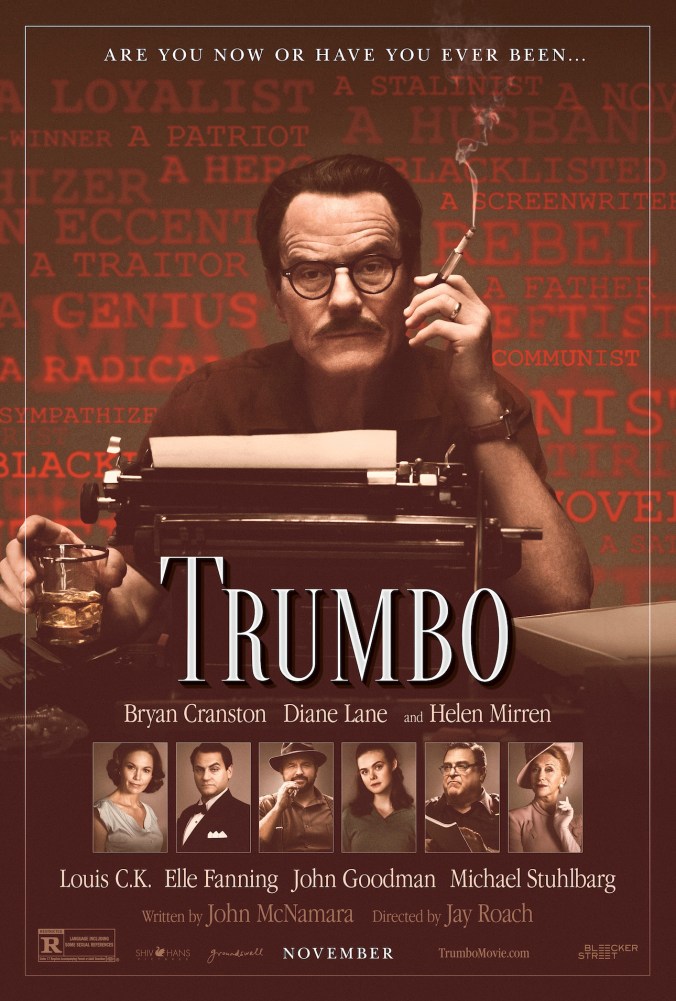
trumboposterThere have been a number of movies in the last year that have been, despite their excellence, particularly hard to watch. Selma comes to mind, as it was difficult not to juxtapose yesterday’s historic struggle for voting rights for African Americans with today’s dispiriting attempts to roll those same rights back and disenfranchise those same people. Suffragette elicited a similar reaction, presenting a striking dramatization of the struggle of women to achieve social justice and independence, released during this year in which women’s rights are under cynical and flagrant attack once again.
The new film, Trumbo, presents a similar intellectual anxiety.

The true story of an Oscar-winning screenwriter blacklisted during the ugly McCarthy era in America, Trumbo stars Bryan Cranston in the title role of Dalton Trumbo, and he delivers a pitch-perfect performance full of wit and rage and fear and indignation.

Trumbo unfolds in an American era in which the country was deeply divided by fear and mistrust, much of it stemming from a mysterious foreign menace that seemed to threaten our way of life…and cynically fueled by opportunistic, craven politicians who saw in that threat the prospect of self-promotion. They questioned the loyalties of people based on the number of vowels or the arrangement of consonants in their last names. Americans whose politics differed from theirs were labeled as traitors. And people were persecuted, victimized, and stripped of their rights despite having perpetrated no wrongdoing nor having committed no crime.

All that resonates as uncomfortably familiar even to those of us who were born long after most of the events of Trumbo take place.

Dalton Trumbo was a communist—which is to say that he was member of the American political party called the Communist Party—and was active and vocal in supporting workers’ rights, unionism, and the First Amendment to the Constitution of the United States. He also was a self-admitted “rich guy”, whose Hollywood success had provided him and his family with plenty to lose when Trumbo decided to stand up the infamous House Un-American Activities Committee. Convicted of contempt of Congress, Trumbo served nearly a year in a federal prison in Kentucky, and when he was released, he was blacklisted from working as a writer.

But Trumbo fought back.

Hollywood has tackled the blacklists before, of course. Robert DeNiro headlined 1991’s Guilty by Suspicion, and George Clooney delivered the consummate prestige picture in 2005, directing Good Night, and Good Luck. Even before those, in 1976, Woody Allen starred in The Front, a simple but effective comedy-drama that had the distinction of being written by (Walter Bernstein), directed by (Martin Ritt), and starring (Zero Mostel, Herschel Bernardi, and Lloyd Gough) a number of artists who themselves had actually been blacklisted.

Trumbo takes a bit from each of those films, combining the personal drama of Guilty by Suspicion with the moral outrage of Good Night, and Good Luck and the dry wit of The Front. The result is a more three-dimensional film that works on multiple levels

The primary joy of Trumbo, though, is watching Bryan Cranston bring to life this strange, unlikely hero. Lurching from moments of thundering indignation to fragile vulnerability and back, Cranston creates a character who is full of contradictions in some ways, but one whose single-minded focus on justice—which just so happens to also mean redemption and security for him and his family—drives him from the opening frames to the closing credits.

The challenge of Trumbo, though, is to embrace and understand that it is neither fiction nor ancient history, and that underneath the drama and entertainment is a moral lesson that can help us understand and interpret the world around us today.

Trumbo would have wanted it that way.

31 Films of Halloween – 10/25/15: Extraordinary Tales

Throughout October, Madison Film Guy will post new mini-reviews/recommendations/musings on contemporary or classic horror films to help celebrate my 31 favorite days of the year: the countdown to Halloween! Today’s film: Extraordinary Tales.

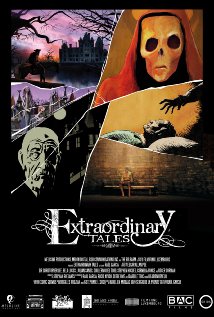
extraordinary

Extraordinary Tales, 2015

Speaking of extraordinary, it has been an extraordinarily tricky proposition to  bring Edgar Allan Poe’s tales to the big screen.

Though many films—and many of them truly great—purport to be based on, inspired by, or loosely adapted from Poe’s masterworks, precious few have been able to actually convey the classic stories or poems as they were intended by the author.

The animated anthology Extraordinary Tales is the exception, and it is a scrumptious appetizer to this year’s delicious Halloween feast, faithfully adapting some of the best entries in Poe’s canon of “love letters to death.”

Loosely organized around a (largely perfunctory, unfortunately) conversation between the spirit of Poe—a raven—and Death herself, Extraordinary Tales spins five beautifully animated tales of madness and terror mostly narrated and/or voiced by masters of horror.

Sir Christopher Lee lends (in an original recording, one of his final performances) his authoritative baritone to the film’s take on The Fall of the House of Usher. Bela Lugosi gets inside the head of the unbalanced murderer of The Tell-Tale Heart. Julian Sands hisses his way through the grim procedural The Facts in the Case of M. Valdemar. Modern master Guillermo del Toro lends his grim tone to the torturous tale of the Spanish Inquisition, The Pit and the Pendulum. And Roger Corman—perhaps in a nod to his own rich catalogue of loose Poe adaptations—voices the decadent Prince Prospero in The Masque of the Red Death.

If Poe’s tales are, as the film notes, “love letters to death”, then Extraordinary Tales must be a love letter to Poe himself. Written and directed by Raul Garcia, who has worked on the animation teams for some of the biggest animated films in recent years, Extraordinary Tales brings each of Poe’s stories to life in a different style and tone. Each singularly captivating. Each gorgeous in its own way. Each expressing an inner or outer horror in ways that live-action filmmaking can rarely capture.

Though all are wonderful, there is particular joy to be found in Garcia’s take on The Tell-Tale Heart. Despite a poorly-recorded voice track (all scratches and hisses and ambient hum) that is thought to be nearly 70 years old, Lugosi’s interpretation of the narrator’s madness—from self-congratulatory calm to desperate paranoid confession—is absolutely intoxicating. At the same time, the gothic animation of the tale is bold and striking.

A close second (though why rank at all?) would be the film’s version of The Fall of the House of Usher, which perfectly captures Poe’s expression of the inexorable decay of the noble bloodline of Usher through the crumbling foundation, the collapsing walls, and the shattering windows of their ancient home.

There may be a more perfect cinematic adaptation of Poe’s greatest works…nevermore.

31 Films of Halloween – 10/15/15: The Green Inferno

OCTOBER 4

Throughout October, Madison Film Guy will post new mini-reviews/recommendations/musings on contemporary or classic horror films to help celebrate my 31 favorite days of the year: the countdown to Halloween! Today’s film: The Green Inferno.

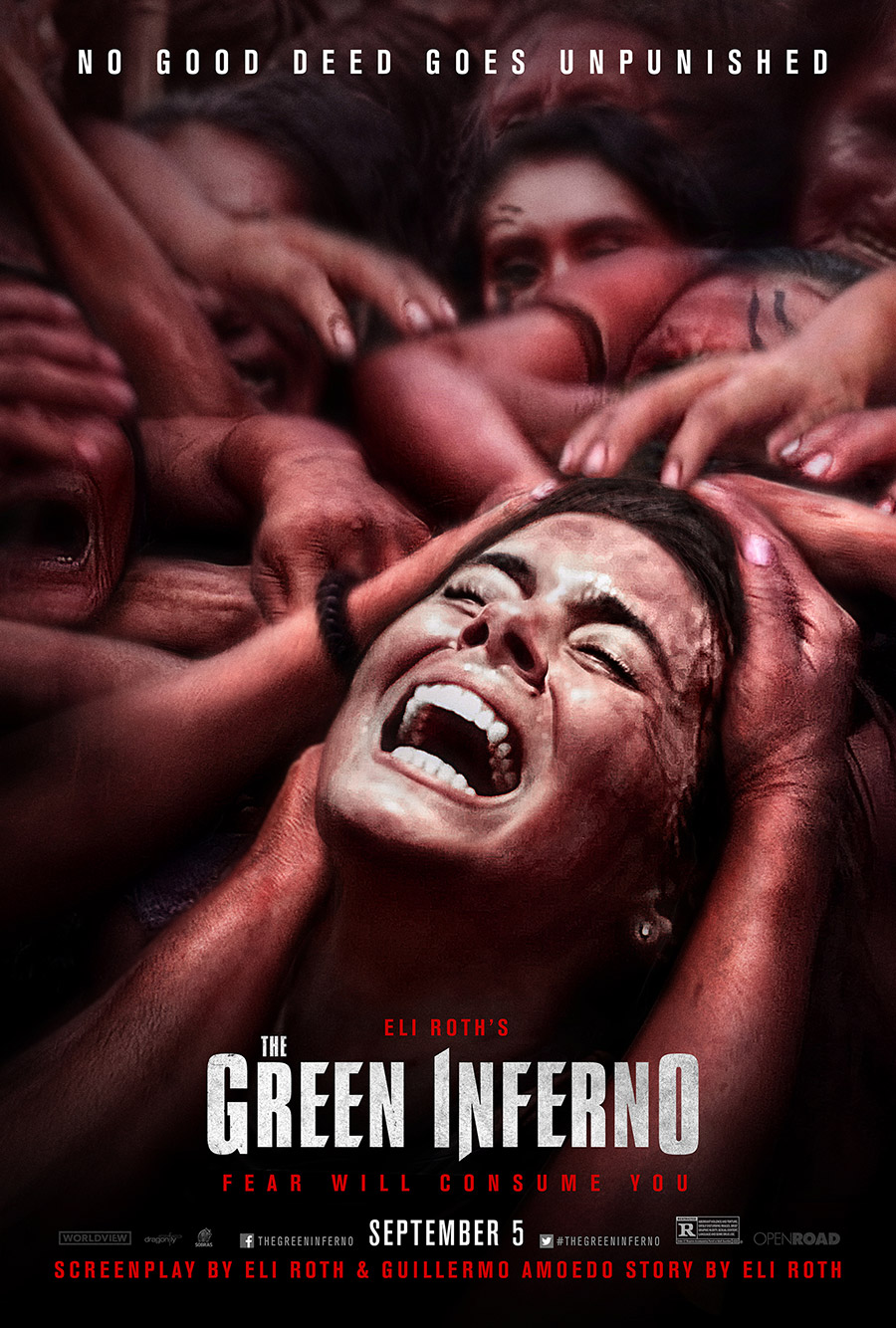
green-inferno-poster-900

The Green Inferno, 2015

The Green Inferno is Eli Roth’s first big screen directorial effort since 2007’s Hostel 2. It’s the story of a group of intrepid college kids who travel to Peru to fight the man, get captured by a lost tribe of indigenous cannibals, and are—by and large—eaten. (Spoiler alert)

Here’s what I learned from The Green Inferno:

1. “Only a freshman would speak with such insolence!” It’s an actual line from the movie. Spoken without irony. So, now you have a feel for the script.

2. Apparently, there is a “lost” tribe in Peru that no other human has ever had any contact with, but that a student at a northeastern college not only knows about but can find after merely a 3-hour boat ride. Just in case you were still thinking that the script might have merit.

3. Indigenous tribe = cannibals. On that there can be no disagreement.

4. If you are at all concerned about female genital mutilation, perhaps just give money to an NGO and skip trying to do something personally to stop it.

5. There are people out there who may murder and eat all the people you know, but that does NOT mean that they aren’t your friends. Don’t judge.

And that, in a nutshell, is The Green Inferno.

Let’s just hope that Eli Roth waits another eight years before directing his next film.

31 Films of Halloween – 10/7/15: Godzilla

Each day during October, Madison Film Guy will post a new mini-review/recommendation/musing on a contemporary or classic horror film to help celebrate my 31 favorite days of the year: the countdown to Halloween! Today’s film: Godzilla.

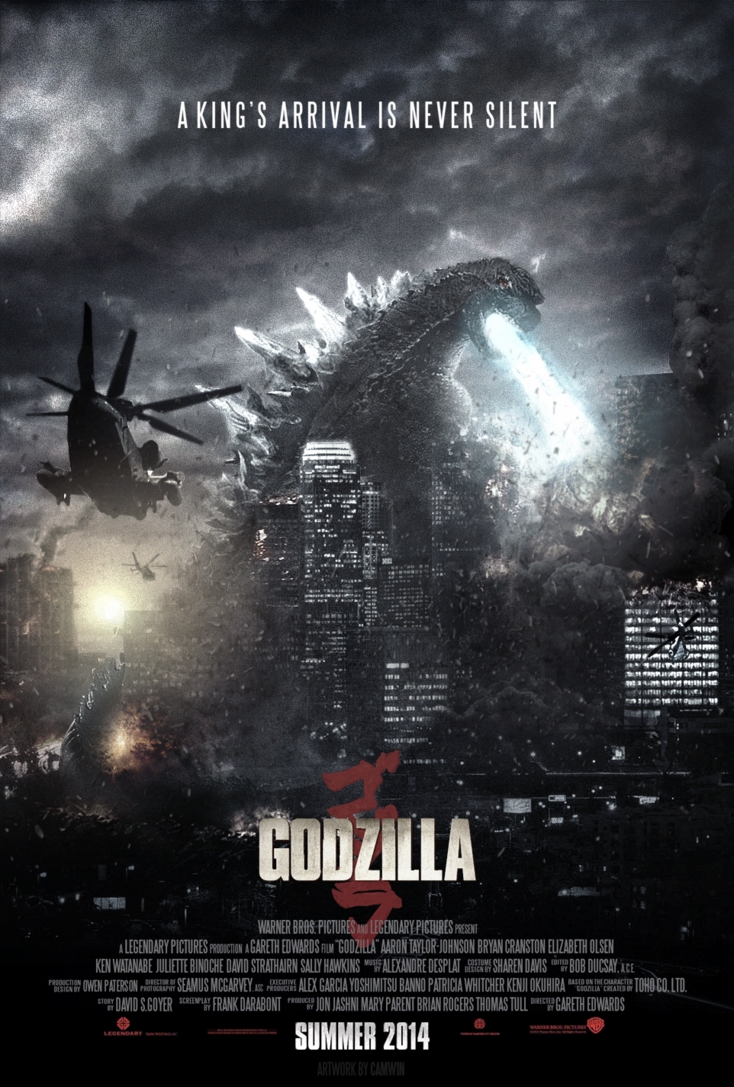
godzilla-poster-1

Godzilla, 2014

When I first saw the 2014 remake of Godzilla, I told anyone who would listen that the film’s opening credit sequence was the most interesting and creative two minutes of film I’d seen all year. The rest of the film? Eh.

But we’ll get back to that in a minute.

Godzilla should have been a much better film. Visually, it’s terrific. Director Gareth Edwards—whose low-budget creature flick Monsters was a special effects revelation—delivers an absolutely wonderfully-designed and constructed title monster, as well as a couple of worthy radiation-fed adversaries for the big man to battle: the MUTO’s (“Massive Unidentified Terrestrial Organisms” for the uninitiated). Whenever Godzilla or the MUTO’s dominate the narrative or the screen, the movie comes to life.

Unfortunately, though, the human protagonists—especially our hero, Aaron Taylor-Johnson, and his long-suffering wife, Elizabeth Olsen—spend their scenes completely sucking the oxygen out of the movie. Dull, uninteresting, and entirely two-dimensional, the human leads seem to understand that nobody is watching this movie to see them, and they offer up performances that live up to that standard. More monsters and less mankind would have made for a significantly better result.

The exception to that rule, however, is Bryan Cranston, who plays a crusading scientist obsessed with unearthing the government conspiracy that he believes led to his wife’s death. Cranston is exceptional in the role—imbuing it with passion and tragedy and real pathos—but the movie casts him aside early on and leaves it in the hands of the next generation. And they fail miserably.

But back to those opening credits.

The first two minutes of Godzilla are a masterclass in creative filmmaking. As the opening credits roll, we are treated to muddy, choppy images that appear to be archival government footage—ostensibly from the 1950’s—presenting Godzilla’s classified backstory. It begins with quick cuts through scientific documents and tantalizing newspaper headlines that hint at some sort of government conspiracy. From there we see snippets of military documents and black and white footage of aquatic military maneuvers. All the while, the credits roll, flashing on screen only to be immediately redacted right before our eyes. And the whole thing builds to a big reveal—a momentary glimpse of Godzilla rising from the ocean—only to be cast back to the depths by a nuclear blast.

It’s brilliant, and you can watch it here:

Godzilla 2014 isn’t awful and it certainly isn’t great. If you’re a fan of creature features, you’ll probably enjoy much of what the movie has to offer…and you’ll definitely geek out at the final confrontation between Godzilla and the MUTO’s. But if you’re not much of a creature feature fan, just watch the two minute clip above, enjoy, and then find a classic horror film on TV (or elsewhere!) to fill the rest of your evening. It will be a much better use of your time.

31 Films of Halloween – 10/3/15: The Babadook

Each day during October, Madison Film Guy will post a new mini-review/recommendation/musing on a contemporary or classic horror film to help celebrate my 31 favorite days of the year: the countdown to Halloween! Today’s film: The Babadook.

THE_BABADOOK_TeaserQuad

The Babadook, 2014

One of the most interesting and inventive horror movies of the last year has been, hands down, Australia’s The Babadook.

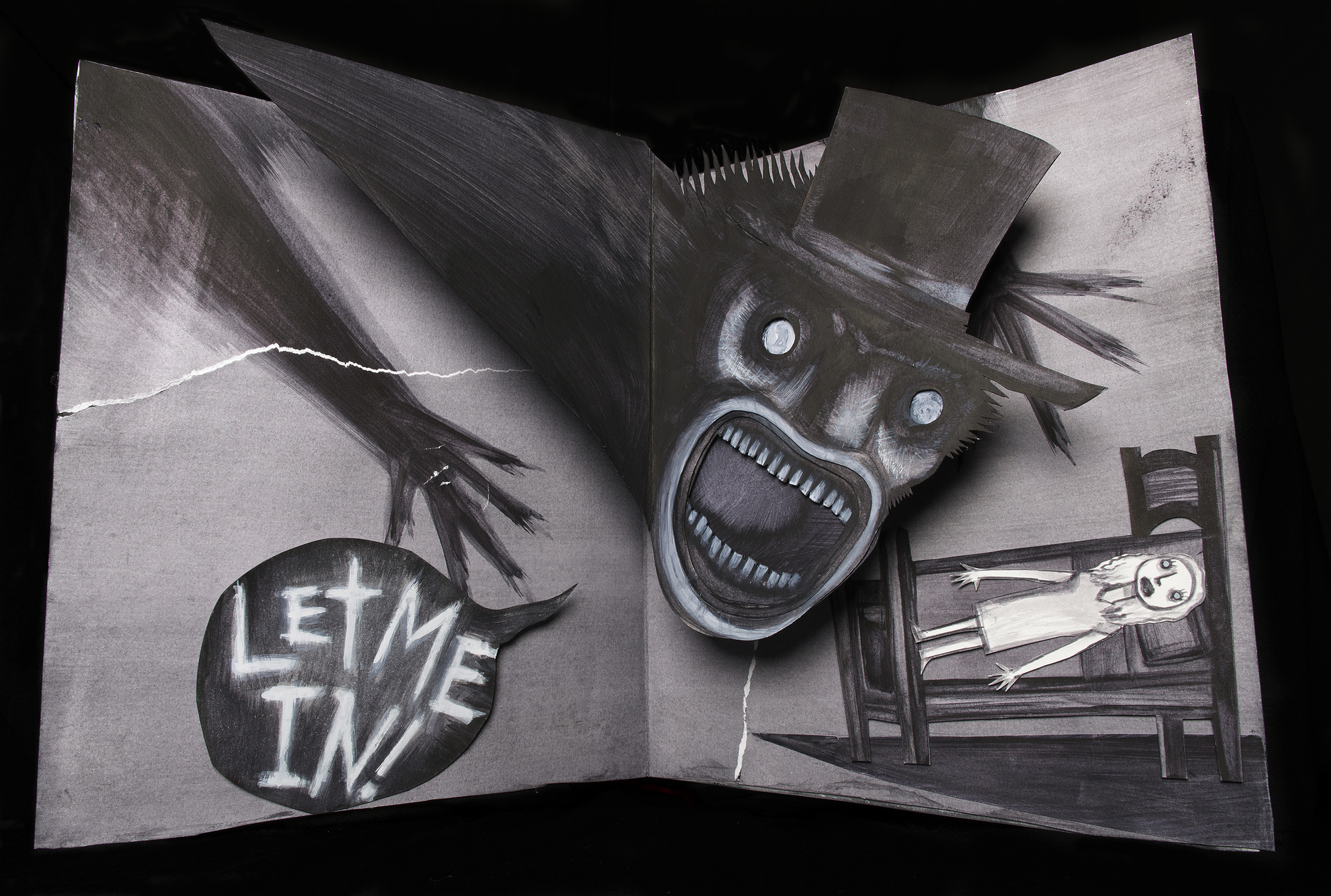
Based on her own short film “Monster” (click here to watch “Monster” for free), The Babadook is an intimate little horror film about a difficult child (Sam), an exhausted mother (Amelia), and the demon that haunts them (the B himself). The demon of the title is actually the subject of a sinister popup book, Mister Babadook, which pops up mysteriously in Sam and Amelia’s troubled home one night. When Amelia reads the book to Sam at bedtime, she becomes disturbed by the violence it depicts and the strange resemblance the book has to their home and their life. Amelia tears up the book and throws it away, but if that were the end of the Babadook, then The Babadook wouldn’t be a very interesting film.

The best parts of The Babadook put atmosphere before action and character before carnage. Truth be told, Sam and Amelia don’t need a demonic interloper to make their relationship difficult. The loss of Sam’s dad and the helpless desperation of Amelia’s struggle with single motherhood pose problems aplenty for them, and when Mister Babadook does show up, it is practically a relief in that it gives them a problem that they might actually have a shot at solving. The nuance and maturity with which Kent depicts that difficult relationship creates investment in the characters and ultimately drives the emotional impact of the film.

The Babadook himself—whether viewed on the pages of Mr. Babadook or spied in the background of the frame for just an instant—is a creation of pure nightmare, with an affectionate nod to early horror cinema. Kent has said that she based the look of the creature on Man of a Thousand Faces Lon Chaney’s famous makeup from London After Midnight, the lost film that exists today only in the still photos that represent all that’s left of the film.

lonows_141832556012285

Her homage to that 1927 film gives The Babadook a classical feel, suggesting a film that does not belong to this time but that could have come from any number of past eras of horror.

Regardless of where or when it comes from, however, The Babadook succeeds the fundamentals of horror: creeps, screams, and scares.

And once you have that, it’s hard to ask for much more.

The Visit

thevisit

Think about all the great twist endings in film history.

Our introduction to mama Bates in Psycho. The legend of Keyser Soze in The Usual Suspects. Darth Vader’s confession in The Empire Strikes Back. Taylor’s discovery in the final seconds of Planet of the Apes. The unmasking of Louis Cyphre in Angel Heart. The ghosts of The Others. The secret to the magician’s success in The Prestige.

There have been lots of great ones over the years, but no twist has ever matched the final big reveal of The Sixth Sense.

More than just a great surprise ending, though, the genius of The Sixth Sense was how writer/director M. Night Shyamalan teased viewers with so many bread crumbs and signposts throughout the film. The answer was right there in front of us all along, and yet—when the ending came—we were all knocked on our collective backside. In fact, the greatest pleasure of The Sixth Sense may not even be the ending, but rather the second viewing, when you get to go back and laugh at yourself for all the clues you missed.

Ever since The Sixth Sense, Shyamalan has been chasing an impossible dream—trying repeatedly to recreate the formula—but has consistently fallen far short of the mark.

The Visit has been billed as Shyamalan’s return to form, but while the film offers plenty of creepy atmosphere and some legit jump-out-of-your-seat scares, its big (for lack of a better word) reveal is so telegraphed and predictable that the whole thing ends up feeling like a major letdown.

Becca and Tyler have never met their grandparents, who have been estranged from their mother, Paula, since long before the two kids were born. When the elderly couple reaches out to Paula through the Internet, however, she happily ships her kids off for an unchaperoned week long visit, pretty much no questions asked. You know, just like any mother would. It doesn’t take Becca and Tyler long to realize, though, that Nana and Pop Pop are just a bit strange—maybe more than just a bit, in fact—and as the week unfolds, their eccentricity quickly evolves into something far more sinister.

Despite its ultimate failings, The Visit succeeds in its slow burn and not-immediately-clear revelation of Nana’s and Pop Pop’s peculiar peculiarities. Is there something unstable and dangerous about them, or are they just, well, old?

Pop Pop disappears regularly into an old shed, but is he really hiding something back there or just doing his chores? Nana crawls around under the house chasing the kids, but is she just playing or are they really in danger? Shyamalan skillfully dances around those questions by lurching back and forth from moments of tension and suspense to frequent releases of the safety valve of humor. Over and over, he sets in motion the elements of full-blown horror and then backs off, letting the audience laugh off the tension and then immediately cranking it back up.

The best parts of The Visit are the unnerving little set pieces constructed around Nana’s instability. After bedtime, she stalks around the house like an animal, terrifying her visitors, who are essentially trapped in their room. During the day, she asks Becca to climb into the kitchen stove to clean it…and then menacingly encourages and prods the girl to go deeper—all the way—into it. And when Becca tries to ask her about what happened the day Paula left home for good, Nana becomes completely unhinged.

Tony Award-winning actress Deanna Dunagan plays Nana perfectly, shifting effortlessly between sweet-but-eccentric grandma and deranged murderess. Whether she’s laughing, screaming, grunting, growling, cooing, calming, soothing, or stone silent and motionless in moments of terrifying stillness: every note she hits is absolutely pitch perfect.

The worst part of The Visit—other than the letdown twist, that is—is the monumentally ill-conceived creative choice to present the film in first-person perspective, documentary style. Becca is a real film prodigy, you see, and so she has decided to film the entire visit and turn it into a family documentary. As a result, we are supposed to understand The Visit as the final assemblage of documentary footage that Becca and Tyler have shot over the course of the week.

That creative decision fails spectacularly.

In addition to it being a completely overused filmic device, Shyamalan never makes any effort to suggest that the scenes or even individual shots might actually have been shot “reality style” by the characters. Every single shot—indoor and outdoor—is perfectly lit, remains in sharp focus throughout the entire depth of field, and somehow keeps all the action of every scene perfectly within the frame. Even when a camera is dropped, the resulting “accidental” framing presents a perfect shot with the kind of mise en scene that would take Steven Spielberg a day and a crew of dozens to construct.

The difference between Shyamalan and Spielberg—to whom Shyamalan was frequently compared after The Sixth Sense—is that Spielberg made an early, landmark masterpiece (Jaws) and then followed it up by topping himself over and over and over and over again. Shyamalan has never even come close to matching, much less topping, his early success. And it is unlikely that he ever will.

That doesn’t make him a bad director, of course, any more than The Visit’s failings make it a bad film. It has its moments, just as Shyamalan does.

In the end, though, both film and filmmaker suffer from a serious case of the could-have-been’s.

Mistress America

mistressposter

Who would have guessed that we might start to recognize a distinctive “Greta Gerwig” style of cinema?

Filmic sensibilities are an odd and difficult thing to define, but we know them when we see them. Woody Allen has a distinct sensibility and so does Martin Scorsese…and those two are in no way similar. Some films—whether tied to their namesakes or not—are easily catalogued as Capra-esque or Hitchcock-ean. And pretty much anyone who sees more than one movie a year can spot a Quentin Tarantino movie before the opening credits are done rolling.

But Greta Gerwig?

Indeed, the indie actress-cum-screenwriter has emerged in recent years as an idiosyncratic cinematic voice, with her latest film, Mistress America, a minor-though-charming addition to her growing and impressive filmography.

Mistress America, which Gerwig stars in, co-produced, and co-wrote with director and best beau Noah Baumbach, is an unexpansive meditation on loneliness, narcissism, and the cult of (failed) ambition. And, like much of Gerwig’s most personal work to date, it delights in the struggle of a generation desperate to find its place as it comes to terms with the twilight of youth and the dawn of adulthood.

Tracy, played with compelling angst by Lola Kirke, is a lonely college freshman, an eager fresh face in New York City. She dozes off in class. The school literary society rejects her. And the boy she’s crushing on finds another girlfriend. Not an auspicious start to the rest of her life. But on a whim she calls up Brooke, her soon-to-be stepsister, who is ten plus years her senior, lives in Times Square, and leads an impulsive and adventurous city life. Tracy’s mom is marrying Brooke’s dad, and although the two girls have never met before, they immediately bond…and Tracy’s whole existence transforms from still-life black-and-white to full-motion Technicolor.

Theoretically, this is Tracy’s story, but the movie—like everyone who comes in contact with her—is drawn to and fueled by the ultra-charismatic Brooke.

Gerwig writes and plays Brooke as a narcissistic force of nature: a whirlwind of egocentric observations, insights, schemes, and dreams. She survives on pure brute force of personality, living off of a combination of odd jobs and utilitarian relationships. And despite a nearly clinical case of self-absorption, Brooke appears to be the only one in her orbit who fails to see that—regardless of her magnetism—she is completely and utterly doomed to failure. She fails see it, yes, but you get the sense that deep down she is beginning to suspect it.

Regardless, Brooke is madly in love with Brooke, even though Brooke is the kind of person who would absolutely hate Brooke if she wasn’t actually Brooke. But maybe that’s how we all really feel about ourselves.

Gerwig’s cinematic baptism has come at the altar of filmmakers like Whit Stillman and Baumbach himself, and it shows in her scripting of Mistress America. And that’s not a bad thing. Though less self-conscious—but dramatically warmer—than movies like Metropolitan or Damsels in Distress (which Gerwig starred in, as well), Gerwig the writer shares a talky, erudite style with Stillman and Baumbach. But her earthy, human moments are significantly more impactful and resonant.

When Anna, a forgotten high school classmate, approaches Brooke in a bar and confronts her over an episode of emotional bullying from years gone by, Brooke is bewildered. She dismisses Anna’s condemnations with a casual, callous rebuke, and then later laughs off the incident and catalogues it as a story to share with friends.

Or maybe just a tweet.

Irrational Man: Philosophy & Justice

irmposter

Watching a Woody Allen movie these days is akin to watching a great athlete in the twilight of his career.

Every now and then you get to see a vintage performance, a reminder of the self-assured mastery and skill that once made this guy the greatest in the world. Every now and then he’ll go long stretches where he’s on top of his game and looking like the champion of old—filling up the stat sheet and wowing you with his ability to stay with the other players—only to falter on a few key shots or run out of gas at the end. And every now and then he throws up a complete brick, nearly missing the mark entirely and leaving you shaking your head and hoping he has what it takes to make on last run at a championship.

Unfortunately, despite a solid effort by his actors and some interesting moments here and there, Allen’s latest annual offering, Irrational Man, is more brick than anything else. It looks good coming off his fingertips, arcs encouragingly toward the basket, but ultimately clanks awkwardly off the rim and way, way out of bounds.

The Irrational Man at the core of the movie is Abe Lucas, a brilliant but troubled philosophy professor just beginning a new job at Braylin College, a fictional school in the northeast where the undergrads all talk like 40-year-old liberal elites and the co-eds have never heard of “Russian Roulette”. We know that Abe is brilliant but troubled because character after character carefully explains to us again and again and again and again and again—ad nauseam—that he is brilliant but troubled. Abe, floundering in the throes of a serious existential crisis, strikes up a friendship with one of his top students, Jill, who quickly falls for him. We know that she has fallen for him because character after character carefully explains to us again and again and again and again and again—ad nauseam—that she has fallen for him.

In case you’re not getting it on your own and need me to explain it to you: the worst flaw in Irrational Man is that Allen’s script constantly assumes that the audience just isn’t getting it and needs everything explained to them, over and over and over again. Jill has the same conversation with her boyfriend about her relationship with Abe at least three times. When the film pivots suddenly in its second half and there is a crime to be solved, one character’s theory is repeated no less than four times by various characters. And on and on. The repetition becomes so striking that it begins to appear almost strategic, but it ultimately just derails the movie’s momentum and leaves the viewer somewhat bored in slogging through the same material over and over again.

During one of their pseudo-dates, Abe and Jill find themselves at a diner, where they overhear a stranger’s heartbreaking story about how she is about to lose her children in a divorce. In that moment, Abe makes a life-altering decision, which propels Irrational Man in an unexpected–though more interesting–direction and gives meaning and purpose to his life.

Suddenly the cloud over Abe lifts. He begins to enjoy life again. He writes, he lusts, and he loves.

“What happened to the philosophy professor?” marvels a fellow faculty member with whom Abe is having an affair. “Christ, you were like a caveman!”

It’s a compliment.

From there, Irrational Man actually starts to pick up some steam. Abe sets his course, plots and plans, and acts—he says—for the first time in his life.

Woody Allen has written some beautiful dialogue in his career, brought to life some lively characters, and laced his screenplays with delicate irony, razor-sharp wit, and even instances of true suspense. Manhattan, Hannah and Her Sisters, and Match Point are just three illustrations of what has evolved into a monumental canon of excellent films that succeed in one or more of those areas.

withwoody

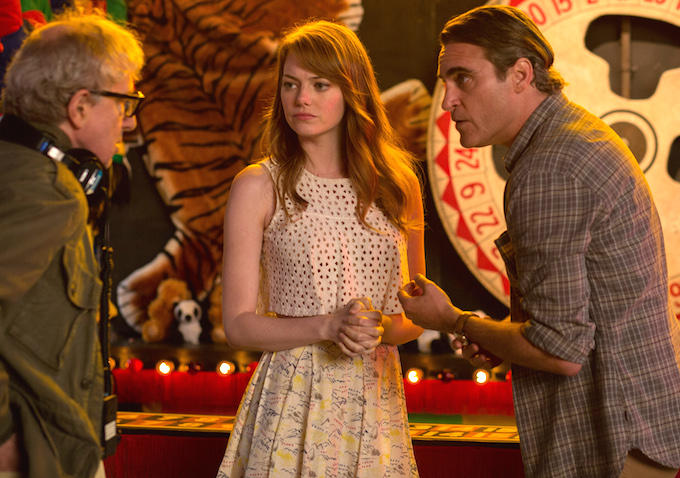
But where Irrational Man actually succeeds has little to do with Allen’s direct contribution, but rather comes from the entirely game performances of the three leads: Joaquin Phoenix and Emma Stone in the two top roles, and Parker Posey as Abe’s colleague and lover, Rita. All three transcend the material and develop interesting, compelling characters that live and breathe and manage to keep us interested despite it all. Stone and Posey, in particular, do far more with their roles than one might expect, given what they have to work with. To a large extent, they are drawn as caricatures—as is Abe, for that matter—but their interpretation of their dialogue and ability to fill the empty spaces with empathy and real emotion adds blood and life to the film.

Phoenix keeps pace with the ladies, for the most part, but he suffers from the fact that he plays a character that never lives up to its own billing. Jill and Rita and other minor characters rhapsodize over Abe’s brilliance, but in the end we never really see it. His philosophical declarations are of the Philosophy for Dummies variety, and his fetishizing of joylessness rises to the level of your average college sophomore. As a result, it just becomes too hard to believe Phoenix’s performance because his character rings so hollow.

Despite it all, Irrational Man does offer the occasional nugget of satisfaction here and there, and its climatic moment is surprisingly intense and effective. Rarely has Allen’s presentation of violence been so raw and sudden, and punctuating a film that has seemed so lazy to that point with such a startling moment only amplifies its power.

In Match Point and Cassandra’s Dream, Allen offered competing positions on whether crime must be punished. And though Allen never resolves the philosophical issues he raises in Irrational Man, he does definitively break the tie on the question of whether or not justice must be served.